How do you build a conference budget a year ahead?
Start 12 months out with a full cost list and a 10 to 15 percent safety margin. Map every payment date against the income you expect, so you can see the tight months early. Keep the money in a separate high-yield account, book your main suppliers six to eight months out, and review the conference budget every month until the doors open.
Planning a large conference often feels like building something while it’s already moving. Costs show up in waves, suppliers want commitments before you’re ready to give them, and income tends to arrive later than the bills. None of that is unusual. The strain comes from facing all of it at once, with too little time to respond calmly.
A year of lead time is the simplest fix. It turns a stack of urgent payments into a series of manageable steps, each with its own moment on the calendar. Here’s how to use that year well, starting from the first rough estimate and ending with the final weeks before the doors open.
See the 12-month timelineJump to the FAQ
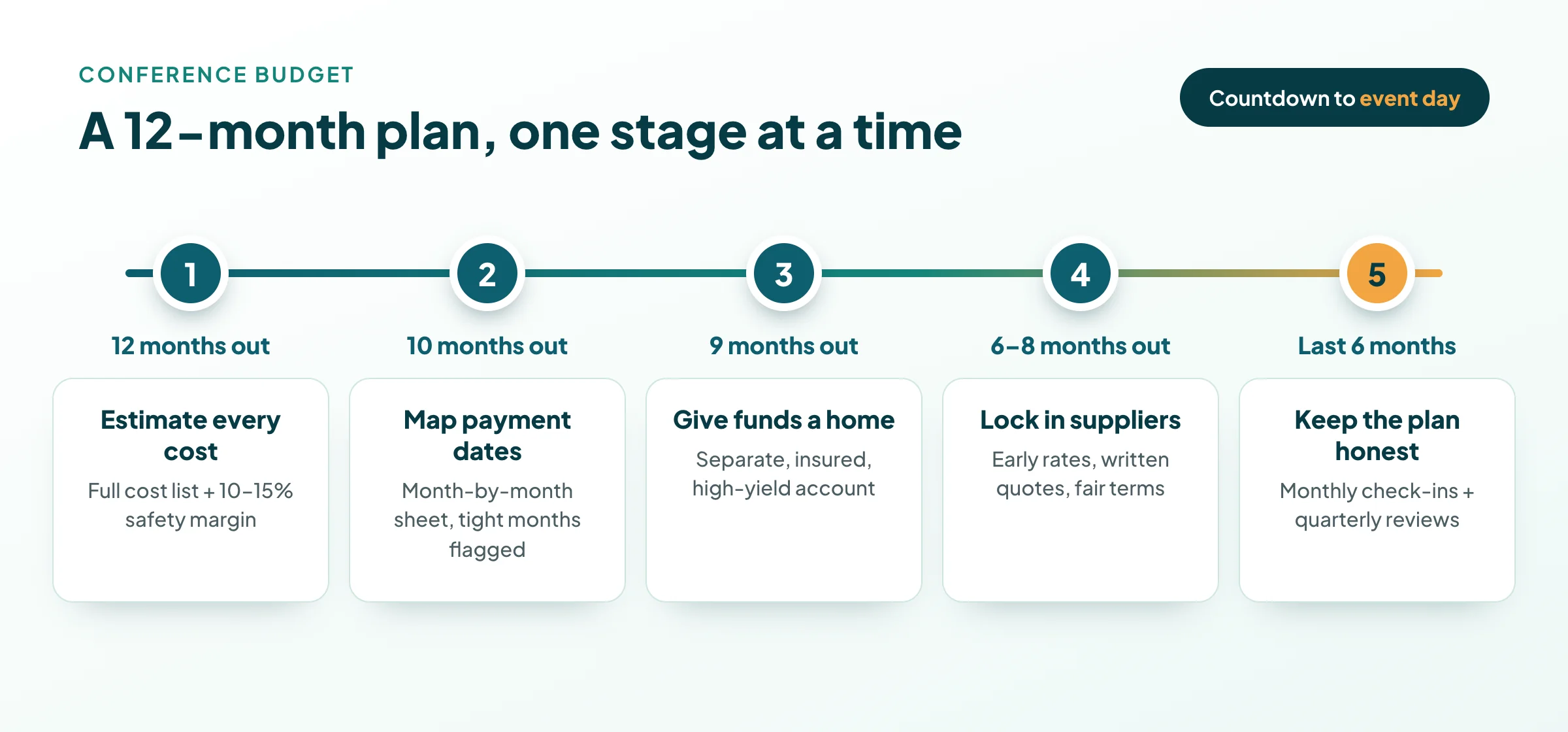
Conference budget timeline at a glance
Each stage of the year has one main job. Use this table as your conference budget roadmap, then read the detailed steps for each stage below.
| متى | المهمة الرئيسية | ما الذي تنهي به؟ |
|---|---|---|
| 12 أشهر خارج | Estimate every cost and add a 10 to 15 percent safety margin | A full cost list, with at least two quotes for each big item |
| 10 أشهر خارج | Map when each payment is due and when income arrives | A month-by-month sheet with the tight months marked |
| 9 أشهر خارج | Move the funds into a separate high-yield account | Money that is visible, insured and earning while it waits |
| من 6 إلى 8 أشهر | Book the venue, catering and AV while calendars are open | Written quotes with fair cancellation terms |
| الأشهر الأخيرة 6 | Run monthly check-ins and a bigger review each quarter | A plan that still matches reality, with changes made in time |
Twelve Months Out: Put an Honest Number on Paper
The whole year rests on your first estimate. Get it right, and every later decision has solid footing. Get it wrong, and you’ll spend months chasing a gap you created on day one.
List What You’ll Actually Pay For
Start with the obvious costs and keep going until you run out of ideas. The venue and its setup fees. Food for every meal and break, priced per person. Sound, screens, lighting and someone to run them. Speaker fees, flights and hotel rooms. Then the smaller items that are easy to forget: insurance, name badges, printed signs, Wi-Fi upgrades, ticketing fees, card processing charges and extra staff for the event days.
For the big items, ask at least two suppliers for a quote. One price tells you what a single company wants to charge. A few prices tell you what the job is really worth.
Tick off each line as you add it to your first conference budget draft:
اترك مجالاً لما هو غير متوقع
Something will always cost more than you planned. A flight changes, or a venue adds a fee that wasn’t in the first draft. Set aside 10 to 15 percent of your total as a safety margin, and only use it for genuine surprises. If you find you simply forgot a cost, add it to the main budget and refill the margin.
Prices also move over a year. A quote you get in January might not hold by autumn. Looking at recent figures from the Consumer Price Index published by the U.S. Bureau of Labor Statistics gives you a sensible guide for how much to pad any cost you haven’t locked in yet.
Ten Months Out: Find Out When the Money Has to Move
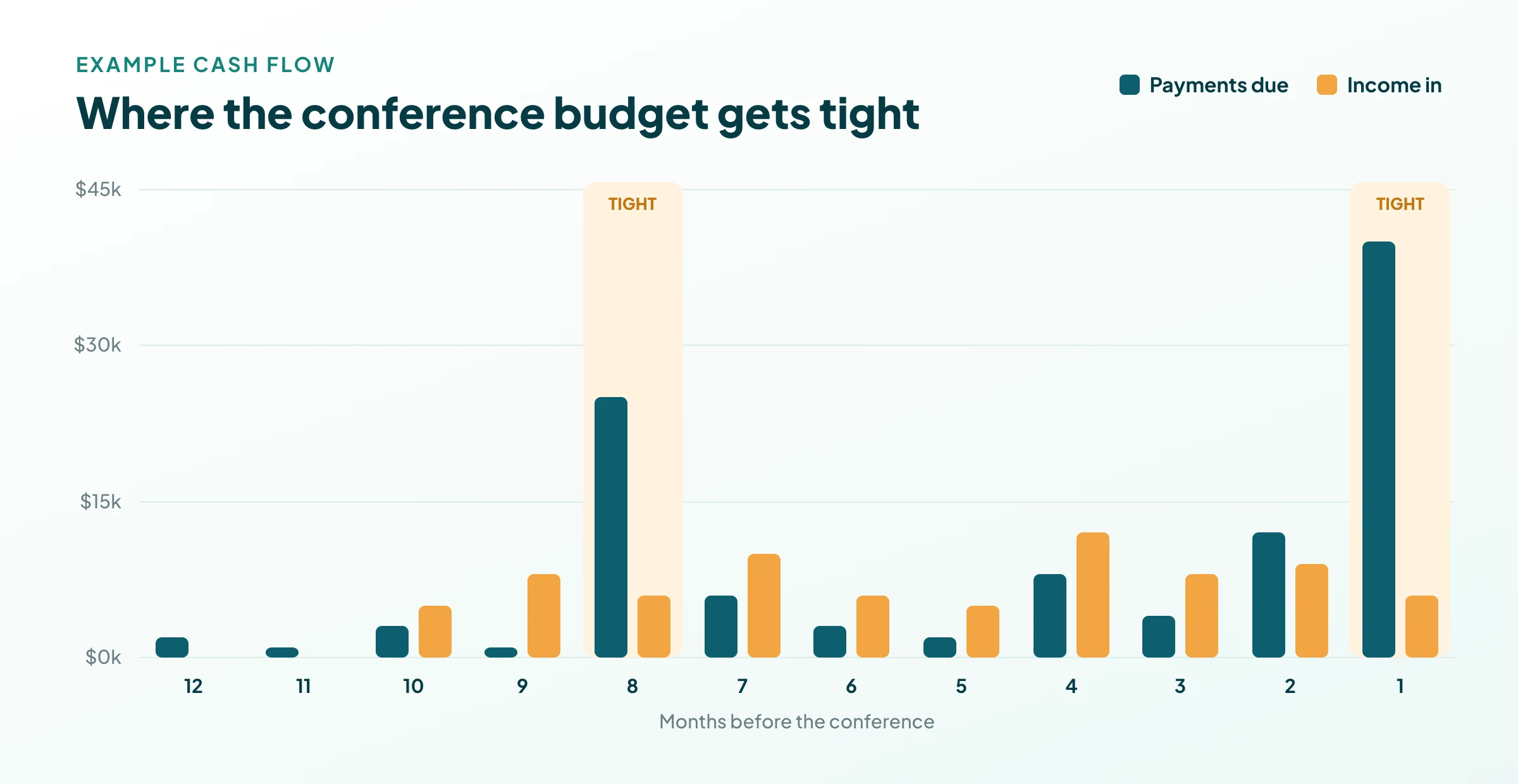
Knowing your total is only half the picture. You also need to know when each payment is due, because a budget that looks fine overall can still leave you short in a single month.
Put Every Due Date on One Page
Venues usually ask for a deposit when you sign, often a quarter to half of the fee, with the rest due a few weeks before the event. Caterers tend to want final numbers and payment close to the date. Hotels holding a block of rooms may charge you if fewer guests book than you promised. Write each payment on a simple month-by-month sheet with the amount next to it.
Spot the Tight Months
Now add the money you expect to come in. Early ticket sales, sponsor payments, grants or funding from your organization all go on the same sheet. Wherever spending runs ahead of income, you’ve found a tight month. Those are the months you’ll need cash already saved, which is exactly why the next step matters.
Bring income forward: early ticket revenue is the easiest way to soften a tight month. Our guide to تسعير تذاكر الفعاليات الذكية covers tiered prices, and why early bird pricing fails explains how to set deadlines that actually pull sales forward. For sponsor income, a clear عرض تقديمي لرعاية الفعاليات helps you close deals early enough for the money to land in your conference budget before the big deposits.
Nine Months Out: Give the Budget a Proper Home
Once you can see the tight months, you’ll notice that much of your money will sit untouched for a long stretch before it’s spent. Where you keep it during that time affects how easy it is to manage and how much you’ll have at the end.
A Separate Account Keeps the Picture Clear
Keeping conference money in the same account as everyday spending is a reliable way to lose track of it. A separate account shows you, at a glance, what you’ve saved and what’s still to come. It also stops event funds from quietly covering other bills, a problem that usually comes to light just as a large deposit falls due.
Idle Money Should Still Be Earning
Money saved in the second month might not be spent until the ninth. In a basic checking account, it earns almost nothing during that wait. In a high-yield account, it can grow enough to pay for a few smaller costs on its own. It’s worth comparing current savings account interest rates from several banks before you choose one, since the difference between an ordinary account and a high-yield option can be larger than you’d expect. If you’d like to see that difference in real numbers, enter your planned monthly deposits into the compound interest calculator on Investor.gov, a free tool from the SEC.
Make Sure You Can Reach It
A strong rate means little if the money is hard to get to. Before you commit, find out how long transfers take, whether there are limits on withdrawals and whether moving money out costs anything. Plan each transfer a few days before the payment date on your sheet, so a slow bank never holds up a booking.
Safety matters too, especially as the balance grows. Check that the bank is covered by تأمين الودائع لدى المؤسسة الفيدرالية لتأمين الودائع and that your total stays within the coverage limit.
Six to Eight Months Out: Lock In Your Suppliers
With your savings plan running, you’re in a strong position to book. Starting early protects your budget, and it can also make it smaller.
Use Time to Your Advantage
A year out, you have choices, and suppliers know it. Venues often give better rates to groups who book well ahead, particularly for dates outside their busy season. Caterers and AV companies may be more flexible too when their calendars are still open. Ask what they can offer for an early commitment. The worst answer is no.
Still choosing a venue or date? دليلنا خطوة بخطوة حول كيفية التخطيط لمؤتمر covers venue selection, speakers and the planning timeline, so your bookings and your conference budget move together.
Read the Fine Print Before You Sign
A low price can hide costly terms. Look closely at the cancellation policy and at any clause that charges you if attendance or hotel bookings come in under the agreed number. A slightly higher rate with fair terms is often the better deal. Get every quote in writing, with a clear list of what’s included and how long the price is valid. People change jobs over a year, and a spoken promise rarely survives that.
The Last Six Months: Keep the Plan Honest
A budget made a year ahead only helps if it stays up to date. Small slips are easy to fix early. Left alone, they grow into problems that arrive at the worst possible time.
Short Monthly Check-Ins
Once a month, compare what you’ve spent against what you planned. Update your savings balance and note any prices that have changed. This rarely takes more than half an hour, and it keeps everyone working from the same figures.
A Bigger Look Each Quarter
Every three months, take a wider view. How are ticket sales tracking? Have sponsors paid what they promised? Have any new costs appeared? If sign-ups are slow, this is the moment to reduce catering numbers or trim extras, while your contracts still allow changes. Making those calls calmly, with time to spare, is far easier than making them in a rush.
If sign-ups are slow: before you cut costs from your conference budget, try to lift registrations. إعادة استهداف الحدث brings back people who viewed your event page without buying, and التسويق عبر الفعاليات الهجينة can widen your audience with a lower-priced virtual ticket. A short, mobile-friendly نموذج تسجيل الحدث also removes friction at checkout.
A simple conference budget template
You do not need special software to manage a conference budget. One spreadsheet with a row for each cost and the columns below covers everything in this guide, from the first estimate to the final check-in.
| عمود | ما الذي يجب تسجيله؟ |
|---|---|
| العناصر | What you are paying for, such as “Venue hire” or “Day 1 lunch” |
| التسجيل كمورّد | Who you pay, with a contact name in case staff change during the year |
| السعر المعروض | The written quote, plus how long that price is valid |
| Deposit and due date | The amount you pay on signing, and when |
| Balance and due date | What is left to pay, and the deadline |
| الحالة | Quoted, booked, deposit paid or fully paid |
| التكلفة الفعلية | What you really paid, so you can compare it with the plan each month |
Add a second tab to the conference budget sheet for income: ticket sales by month, sponsor payments, grants and any funding from your organization. When both tabs are side by side, the tight months show up on their own, and your monthly check-in becomes a quick comparison of planned and actual numbers rather than a search through emails and invoices.
Keep the safety margin as its own line at the bottom of your conference budget. Each time you use part of it, note what it paid for. By the end of the year, that list tells you which costs to estimate more generously next time.
Common conference budget mistakes to avoid
Most budget problems come from a handful of habits. Each one below is easy to avoid once you know to look for it.
- Starting from last year’s totalPrices move, and a copied number hides changes in venue, catering and travel costs. Rebuild the conference budget from fresh quotes.
- Using the safety margin for forgotten costsA missed item belongs in the main budget. Keep the margin for real surprises, or it will be empty when you need it.
- Watching the total but not the datesA budget that balances over the year can still run out of cash in a single month when a big deposit falls due.
- Mixing event money with everyday spendingShared accounts make it hard to see what is saved for the conference, and funds get used for other bills.
- Signing without reading the attendance clausesMinimum numbers for catering and hotel room blocks can cost you money if registrations come in lower than planned.
- Waiting too long to adjustIf ticket sales lag, reduce catering numbers or trim extras while your contracts still allow changes.
Keep ticketing costs out of your conference budget
Ticketing and card processing fees were on the cost list from day one, and on a large conference they add up quickly. Many event platforms take a percentage of every ticket on top of the card fee. Selling tickets on your own website keeps more of that income inside your conference budget.
مع Modern Events Calendar on a WordPress site, you can publish the event, sell several ticket types, take payments and run تسجيل الدخول برمز الاستجابة السريعة at the door, without a per-ticket platform fee. Your payment processor still charges its usual card fees, so keep that line in your budget. If you are still comparing options, our مقارنة بين برامج إدارة الأحداث breaks down the main platforms, and our guide on how to أنشئ موقعًا إلكترونيًا للفعاليات باستخدام ووردبريس يشرح عملية الإعداد.
Conference budget FAQ
How much contingency should a conference budget include?
Set aside 10 to 15 percent of the total conference budget as a safety margin, and use it only for genuine surprises such as a changed flight or a new venue fee. If you simply forgot a cost, add it to the main budget and refill the margin.
When should you start planning a conference budget?
About 12 months before the event. A full year gives your conference budget time to breathe: you have time to collect several quotes, book suppliers at early rates, and spread deposits across many months instead of facing them all at once.
What are the biggest costs in a conference budget?
The venue and its setup fees, catering priced per person, sound and screens with technicians, and speaker fees with travel and hotels usually make up most of the total. Smaller items such as insurance, badges, signs, Wi-Fi and ticketing fees are easy to forget, so list them from the start.
How do you cover payments that fall due before ticket income arrives?
Build a month-by-month sheet of payments and expected income. In the tight months, rely on money already saved in your conference account, and bring income forward with early ticket sales and sponsor payments.
Where should you keep conference funds until they are spent?
In a separate account, ideally a high-yield savings account at an FDIC-insured bank, with the balance inside the coverage limit. Check transfer times and withdrawal limits so the money is ready before each deposit is due.
الخلاصة
Budgeting a year ahead isn’t about finding more money. It’s about giving the money you already have enough time to do its job. An honest estimate gives you a firm starting point, and a clear payment calendar shows where the pressure will fall. A separate savings account keeps funds safe, visible and growing, while early bookings and regular reviews keep everything on track. Taken one stage at a time, the year stops feeling like a race and becomes a plan you can steadily follow.