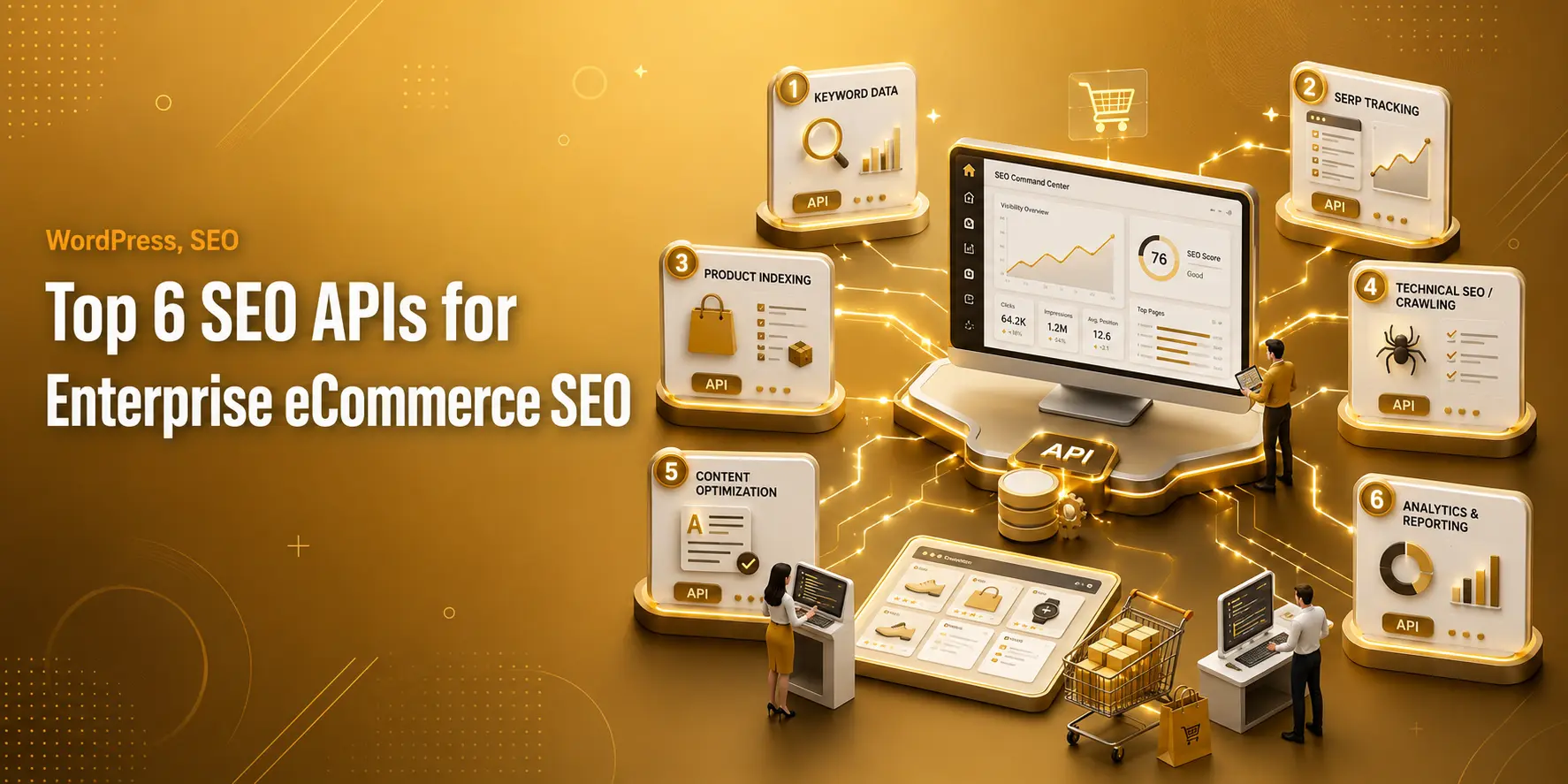
The primary challenge in selecting an enterprise-grade SEO API lies in aligning data pipeline requirements with the correct provider architecture:
- For localized position tracking and structural on-page audits, SE Ranking and Authoritas deliver advanced capabilities, such as coordinate-level geo-resolution and content-type classification.
- For raw, high-concurrency SERP scraping across multiple search engines and international digital storefronts, Bright Data SERP API and SerpAPI are the premier choices.
- If the goal is to access pre-calculated marketing metrics, historical keyword trends, and modeled competitor traffic metrics, Semrush represents the gold standard.
- Finally, Zenserp provides a highly scalable Google-specific JSON parser with exceptionally fast response times.
Choosing a scalable SEO ranking API integration layer requires a deep understanding of these systems.
Key Takeaways
- Architectural Alignment Determines Scalability: Raw SERP scraping APIs (Bright Data, SerpAPI, Zenserp) bypass anti-bot systems to return real-time search results, but they do not provide pre-calculated SEO metrics. Platform APIs (Semrush, SE Ranking, Authoritas) provide pre-built keyword databases and competitive metrics, but they feature lower concurrency limits and higher per-request costs.
- Localization Granularity Varies: Standard platforms offer country-level tracking, but advanced engines like Authoritas support hyperlocal monitoring down to decimal latitude and longitude coordinates, which is essential for brick-and-mortar eCommerce integration.
- Billing Mechanics Impact ROI: Pure scraping APIs use pay-per-success models where failed queries are not billed, lowering infrastructure costs. In contrast, platform APIs use credit-based subscriptions with hard monthly caps and steep overage fees.
- AI Search Visibility is the New Frontier: Traditional position tracking must now be paired with generative search monitoring. SE Ranking leads the market in tracking brand visibility and citation indexing across ChatGPT, Perplexity, Gemini, Google AI Mode, and Google AI Overviews.
Why the Right SEO Data API Matters
Enterprise eCommerce platforms with extensive product catalogs face unique challenges in organic search acquisition. Managing visibility across hundreds of thousands of dynamic stock-keeping units (SKUs) requires a reliable SEO API to serve as the structural backbone of the data engineering stack. Manual tracking is impossible at this scale. Real-time organic visibility directly impacts pricing engines, automated advertising bidding, and inventory placement algorithms.
Managing internal proxy networks, rotating residential IPs, solving CAPTCHAs, and adapting parsers to sudden search engine layout changes is an expensive distraction for in-house engineering teams. The implementation of an enterprise-grade SEO data API resolves these bottlenecks, delivering structured JSON payloads without the associated maintenance overhead. Choosing a lightweight, high-performance SEO rank API allows organizations to delegate proxy management to specialized external infrastructures.
Establishing a programmatic SEO integration API allows e-commerce developers to feed structured datasets directly into Snowflake, BigQuery, or custom visualization suites. A performant API SEO pipeline must resolve programmatic hurdles, including:
- Localized search variations
- Mobile rendering
- Extraction of modern rich snippets
Identifying the best SEO API for an enterprise catalog depends on whether the pipeline requires raw search results or historical database records. For teams tracking search volumes and keyword difficulty scores across international territories, the search for the best SEO data API must prioritize data accuracy and database scale.
The primary point of difference among the best SEO API providers lies in their parsing fidelity and infrastructure reliability. Technical teams frequently evaluate multiple SEO data API providers to bypass the rate-limiting bottlenecks imposed by standard software interfaces. Implementing robust SEO API automation models ensures that competitive intelligence flows directly into business analytics engines without manual export steps.
Quick Comparison: Best SEO Data APIs at a Glance
To evaluate the financial return of SEO API automation workflows, technical directors must match their monthly query volumes against these starting rates.
| Tool Name | Primary Use Case | Best For | Starting Price |
| SE Ranking | Budget-friendly keyword research & AI visibility tracking | Growing eCommerce brands & multi-client agencies | $50.00 minimum deposit |
| Zenserp | Live Google SERP scraping with structured JSON | High-speed, high-concurrency developer pipelines | $29.00/mo |
| Semrush | Deep competitive intelligence & organic traffic analytics | Enterprise eCommerce teams & global agencies | $549.00/mo |
| Authoritas | Page structure analysis & localized position audits | Technical SEO engineers & database integrators | $799.00/mo |
| Bright Data SERP API | Scale-heavy, multi-engine raw search results extraction | High-volume data engineering infrastructures | $1.50 per 1k successful queries (PAYG) |
| SerpAPI | Marketplace scraping & multi-engine structured parsing | Complex multi-channel retail integrations | $25.00/mo |
How We Evaluated These Tools (Methodology)
Evaluating enterprise-grade API SEO tools requires an understanding of how data pipelines function under peak concurrency loads. For organizations evaluating an SEO ranking API as a primary data pipeline, performance metrics must be documented across several distinct vectors. To ensure this assessment remains objective and highly technical, we established five evaluation criteria, which are critical in identifying the best API for SEO integrations:
- We monitored the baseline latency of each search engine rankings API across different regions to evaluate response times under various proxy configurations.
- Next, parsing accuracy was validated by comparing returned JSON payloads against raw search results, ensuring that advanced snippets (such as Paid Product Ads, reviews, and maps listings) were fully extracted.
- Additionally, geolocation granularity was verified by sending queries with city-level and ZIP-code targeting parameters.
- We also analyzed the pricing models to determine how unit costs change as monthly query volumes scale from tens of thousands to millions.
- Finally, developer experience was assessed by reviewing official documentation, code libraries, and API sandbox capabilities.
Our article will definitely help you find the best SEO API service in 2026.
The 6 Best SEO Data API Options
So, let’s discuss the best 6 SEO API services you must be aware of.
SE Ranking
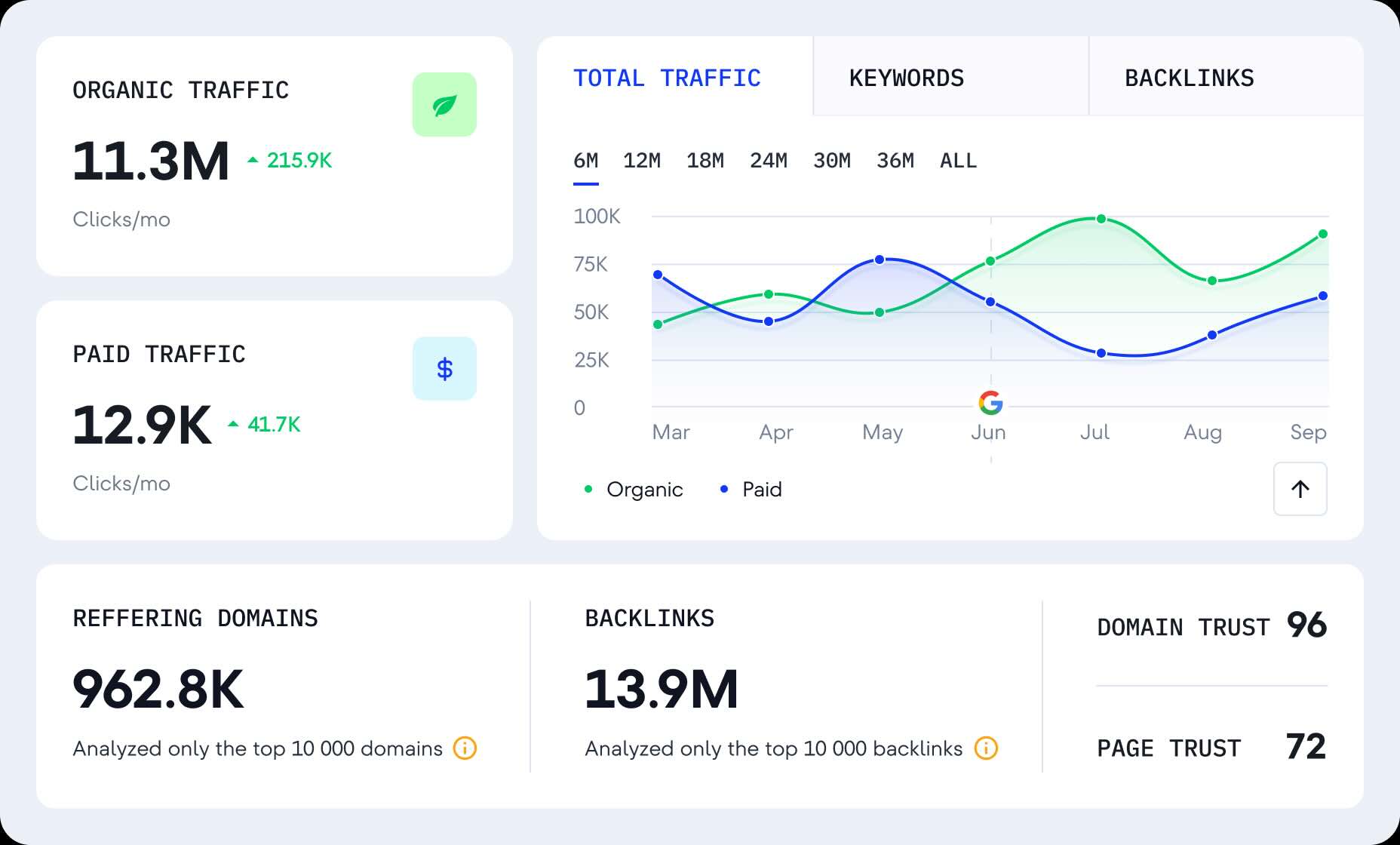
SE Ranking provides a robust all-in-one SEO platform that integrates keyword research, backlink monitoring, and technical site audits. The SE Ranking SEO data API uses a structured credit model that allows enterprise teams to query its massive keyword and competitive databases programmatically. It features two distinct API systems:
- Data API. It runs on a pay-as-you-go model for direct database requests.
- Project API. It connects directly to a user’s subscription limits to automate standard campaign management tasks.
Key features of SE Ranking:
- Dual-API Framework: Uses a single API key to access both the Data and Project API endpoints, drawing from either credit balances or project limits.
- Hyperlocal Geotargeting: Supports position tracking across 188 different Google country databases down to the city and ZIP-code level.
- AI Visibility Tracking: Features a dedicated tracking engine that monitors keyword positioning and citations across conversational AI systems and Google AI Overviews.
- Competitive Intelligence Engine: Allows programmatic extraction of competitor domain traffic, keyword gaps, and historical position tracking.
- No-Code Reporting Integrations: Built-in connections for Google Looker Studio, n8n, Make.com, and custom agency dashboards.
Pricing
SE Ranking offers a highly flexible pricing model that scales across both subscription tiers and pay-as-you-go credit packages. The base Core plan starts at $103.20/month billed annually ($129/month monthly) and includes 2,000 tracked keywords, 10 projects, and 25,000 monthly Data API credits. The Growth tier begins at $223.20/month billed annually and includes 100,000 monthly API credits.
For high-volume requirements, the standalone Data API starts at an effective rate of $318.00/month billed annually ($3,816.00 billed upfront), providing 24 million credits per year. For lower-volume projects, pay-as-you-go credit packs are available starting at $50.00 for 250,000 credits with no expiration. Technical teams can also purchase the API Access Add-on for $159.00/month, which adds 1 million credits to any base subscription. It is accessed programmatically using their robust SEO ranking API endpoints.
Best For
Growing eCommerce platforms and mid-sized marketing agencies looking for a cost-effective, all-in-one reporting and position tracking engine.
Pros
- 188 countries, 420M domains, 6B pages crawled daily.
- Exceptionally cost-effective, costing 60% to 70% less than premium alternatives.
- Free 14-day trial with 100K API credits and full endpoint access from day one.
- Tracks search positions and citations across generative AI systems and Google AI Overviews.
- Backlinks, keyword research, domain analysis, website audit, AI Search, and Project Management API run from a single credit balance under one subscription.
- Excellent technical documentation with fully functional libraries for Python and PHP.
- Prebuilt developer connectors supporting direct syncing with Google Sheets, n8n, and Looker Studio.
- Seamless white-label PDF and Looker Studio reporting capabilities.
- Prebuilt MCP server lets AI agents query rankings and run audit commands using natural language.
Cons
- The proprietary backlink database is smaller than premium alternatives like Semrush.
- Strict API rate limits of 600 requests per minute compared to dedicated scraping networks.
- Enterprise catalog rank tracking can quickly hit standard plan thresholds, requiring frequent credit upgrades.
Zenserp
Zenserp is a high-speed search engine results page (SERP) scraper designed for real-time data extraction at scale. This makes Zenserp an incredibly direct SEO rank API for real-time applications. By integrating a lightweight API SEO layer, engineers can bypass the resource-heavy development of in-house proxy rotators and anti-scraping bypass frameworks. Zenserp provides structured JSON responses that accurately represent what a human user sees on a search results page.
Key features of Zenserp:
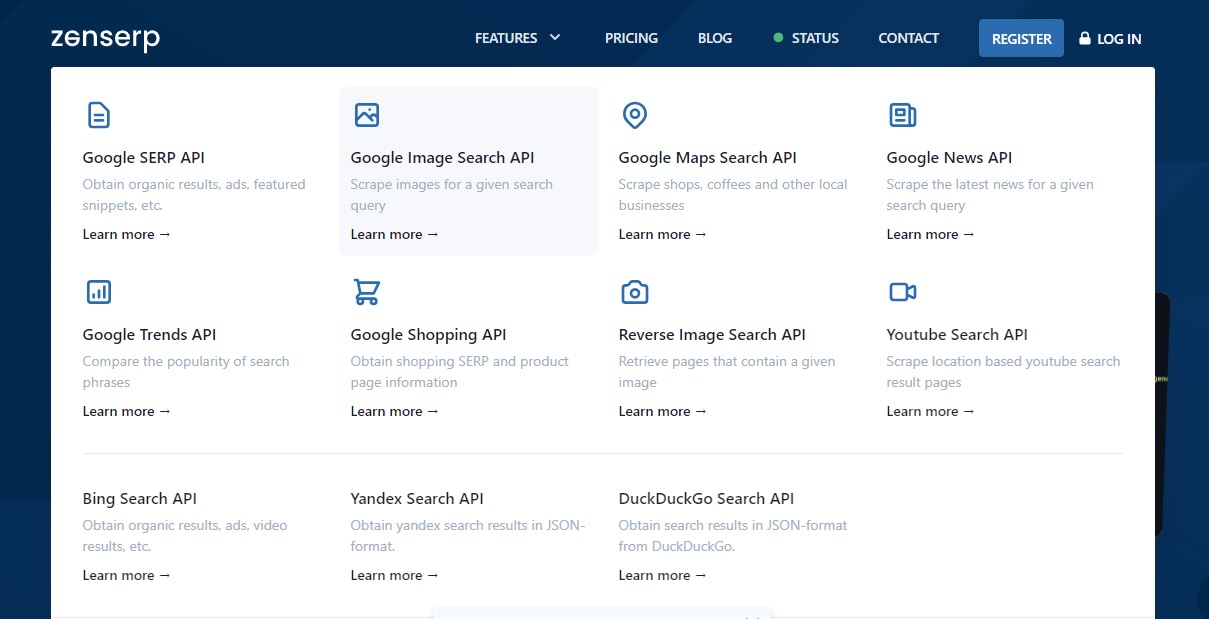
- Multi-Platform Scraping: Supports scraping across Google Web Search, Google Shopping, Google Maps, Images, News, and YouTube Search.
- Automatic CAPTCHA Solving: Features built-in decoding engines that solve search CAPTCHAs instantly behind the scenes.
- Batch Request Endpoint: Allows developers to send bulk keyword arrays asynchronously for parallel processing.
- Rich Snippet Extraction: Automatically parses complex SERP elements, including Knowledge Graphs, Local Packs, and Related Questions.
- Built-in Code Request Builder: A web-based utility that translates configuration parameters into ready-to-run code snippets across multiple languages.
Pricing
Zenserp provides a subscription model that can be upgraded, downgraded, or canceled at any time, backed by a free tier of 50 searches per month. Paid tiers include:
- Small: $29.00 to $49.99/mo for 5,000 monthly searches.
- Medium: $129.99 to $149.99/mo for 20,000 to 100,000 searches, introducing keyword CPC data and batch endpoints.
- Large: $249.99 to $299.99/mo for 50,000 to 250,000 searches with personal support.
- Premium: $499.00/mo for 500,000 searches, including priority queues.
- Enterprise: $899.00 to $1,599.00/mo for 1,000,000 searches, introducing a dedicated SLA and concierge onboarding.
Best For
Developers and technical teams requiring a fast, scalable JSON SERP scraper for real-time inventory and search positioning systems.
Pros
- Sub-second execution speeds backed by robust server infrastructure.
- Rich parsing of complex page elements under a single API call.
- Low barrier to entry with self-service onboarding and pre-built Postman collections.
- Reliable SLAs provided on all subscription tiers starting at the Medium level.
Cons
- Does not maintain historical search databases, requiring technical teams to build their own archives.
- No pre-calculated SEO data such as backlink profiles or technical site audits.
- Purely focused on scraper infrastructure, lacking native keyword and competitive analysis dashboards.
Semrush
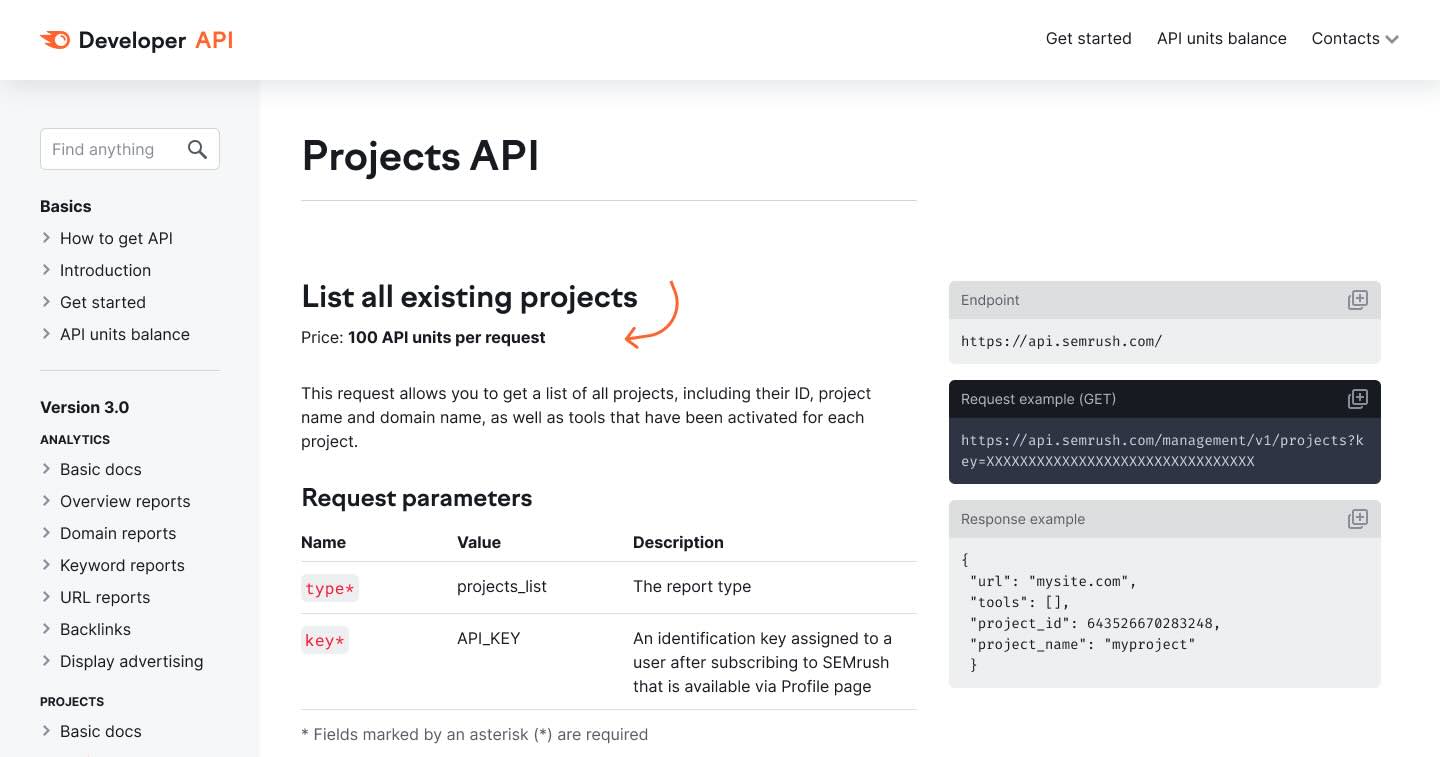
Semrush is a leading enterprise marketing intelligence platform powered by an industry-leading keyword database. Unlike standard platform-based API SEO tools, raw SERP scrapers do not maintain deep historical databases. For organizations whose core metric is database size, Semrush is often cited as the best SEO API available. It allows enterprise development teams to query search metrics directly and ingest competitor data into their business intelligence systems.
Key features of Semrush:
- Unrivaled Keyword Database: Built on a catalog of over 26.4 billion keywords across multiple global markets.
- Competitive Traffic Analytics: Provides estimates of competitor domain traffic, audience overlap, and historical traffic patterns.
- Automated Technical Auditing: Includes a technical page crawler capable of checking up to 1 million pages per month.
- Semrush One AI Visibility: Tracks brand citations, organic positions, and user sentiment across AI Search systems and conversational search platforms.
- Looker Studio and BigQuery Integrations: Connects to enterprise databases for automated competitive dashboards.
Pricing
API access is gated on Semrush, meaning it is unavailable on the Pro ($139.95/mo) and Guru ($249.95/mo) plans. Programmatic database queries require the Advanced Plan, which starts at $549.00/mo.
At this tier, costs can quickly scale based on seat additions and add-ons. For example, adding 4 user seats ($100/mo per seat), the AI Visibility Toolkit ($99/mo per user), Local SEO listings ($60/mo per location), and white-label report builds ($20/mo per report) increases the annual cost of a Semrush integration to $17,352.00.
| Cost Component | Annual Cost |
| Advanced Plan ($549/month) | $6,588.00 |
| 4 Additional User Seats ($100/mo each) | $4,800.00 |
| AI Visibility Toolkit (3 Users at $99/mo each) | $3,564.00 |
| Local SEO (2 Locations, Pro at $60/mo each) | $1,440.00 |
| My Reports (4 White-Label PDFs at $20/mo each) | $960.00 |
| Total Annual Operational Cost | $17,352.00 |
Best For
Enterprise eCommerce platforms and global marketing agencies requiring deep competitor keyword gaps, traffic estimations, and historical search data.
Pros
- Unmatched keyword database size with highly detailed intent metrics.
- Excellent competitor traffic models and programmatic PPC campaign tracking.
- Fully automated reporting integrations with BigQuery and Looker Studio.
- Dedicated account management and enterprise SLAs available for custom plans.
Cons
- Gated API access requires a minimum entry point of $499.95/mo.
- Additional seat costs are high, quickly inflating the budget for larger teams.
- Traffic metrics are modeled rather than sourced from direct analytics, creating variance when compared with Google Search Console data.
- Only supports Google Search scraping, excluding Bing, Baidu, and major e-retail search engines.
Authoritas
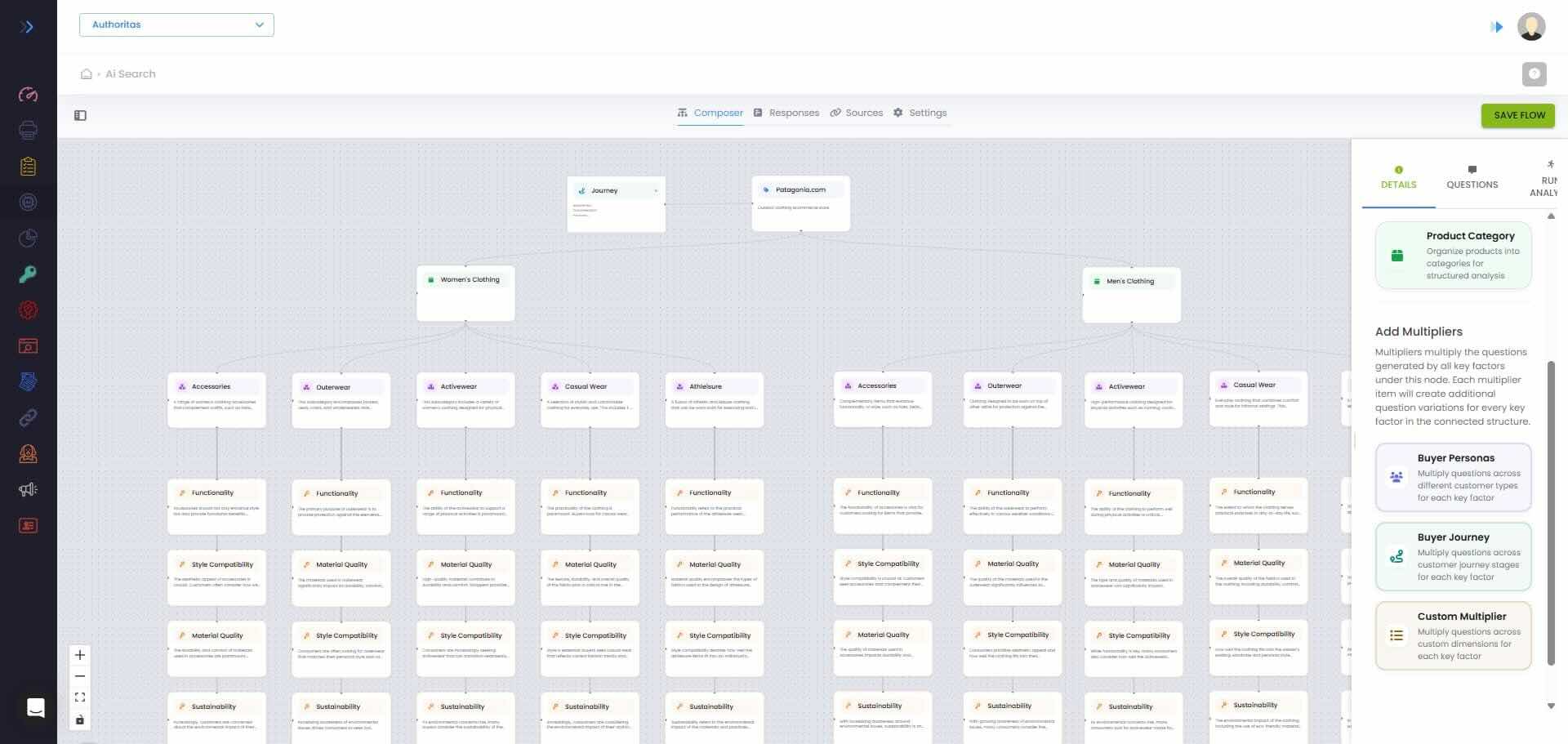
Authoritas is an enterprise SEO engineering suite designed to manage large campaigns programmatically. As one of the best SEO API providers for technical content optimization, Authoritas is built around a data-first approach that connects directly to enterprise databases. Unlike general-purpose scraping proxies, specialized SEO data API providers parse search results into structured, category-level formats. Authoritas provides 3 APIs:
- Keyword Ranking API (SERPs API)
- Page Structure Content API
- Platform API
Key features of Authoritas:
- Page Structure Content API: A unique crawler that analyzes the top 10 SERP URLs, returning page types (Product, PLP Listing, Article, PDF, Wiki), word counts, header structures, and image counts in roughly 10 minutes.
- Hyperlocal Coordinate Tracking: Tracks rank positions with accuracy down to the building level using decimal latitude and longitude coordinates.
- Platform Management API: Provides complete programmatic control over technical SEO projects, audits, and competitor datasets from a central interface.
- Generative Search Monitoring: Tracks brand citation performance and visibility scores across ChatGPT, Claude, Gemini, DeepSeek, Perplexity, and Google AI Overviews.
- BigQuery & Looker Studio Integration: Automates data transfers directly to warehouse environments for enterprise dashboard reporting.
Pricing
The basic Platform API is included at no additional cost for users on Advanced, Expert ($799/mo), and Agency ($999/mo) subscription tiers.
Conversely, high-volume rank monitoring via the SERPs API and structural crawls via the Page Structure API are billed on a pay-per-thousand-queries basis. Volume discounts are negotiated directly with the sales team. To help developers evaluate the platform, Authoritas offers a free trial key pre-loaded with 1,000 queries.
Best For
Enterprise SEO engineers and content strategists needing deep on-page structural insights and coordinate-level localized rank tracking.
Pros
- The unique Page Structure API identifies search intent formatting requirements.
- Coordinate-level local tracking is ideal for multi-location retail brands.
- High scalability backed by a 99.9% uptime SLA and managed proxy systems.
- Robust client cases, such as PriceMinister.com achieving over 40% growth using automated long-tail data.
Cons
- Requires technical software engineering skills to integrate the Page Structure payloads.
- Lacks flat-rate scraping tiers, which can make costs unpredictable at extreme scale.
- The platform’s user interface is complex and geared toward technical practitioners.
Bright Data SERP API
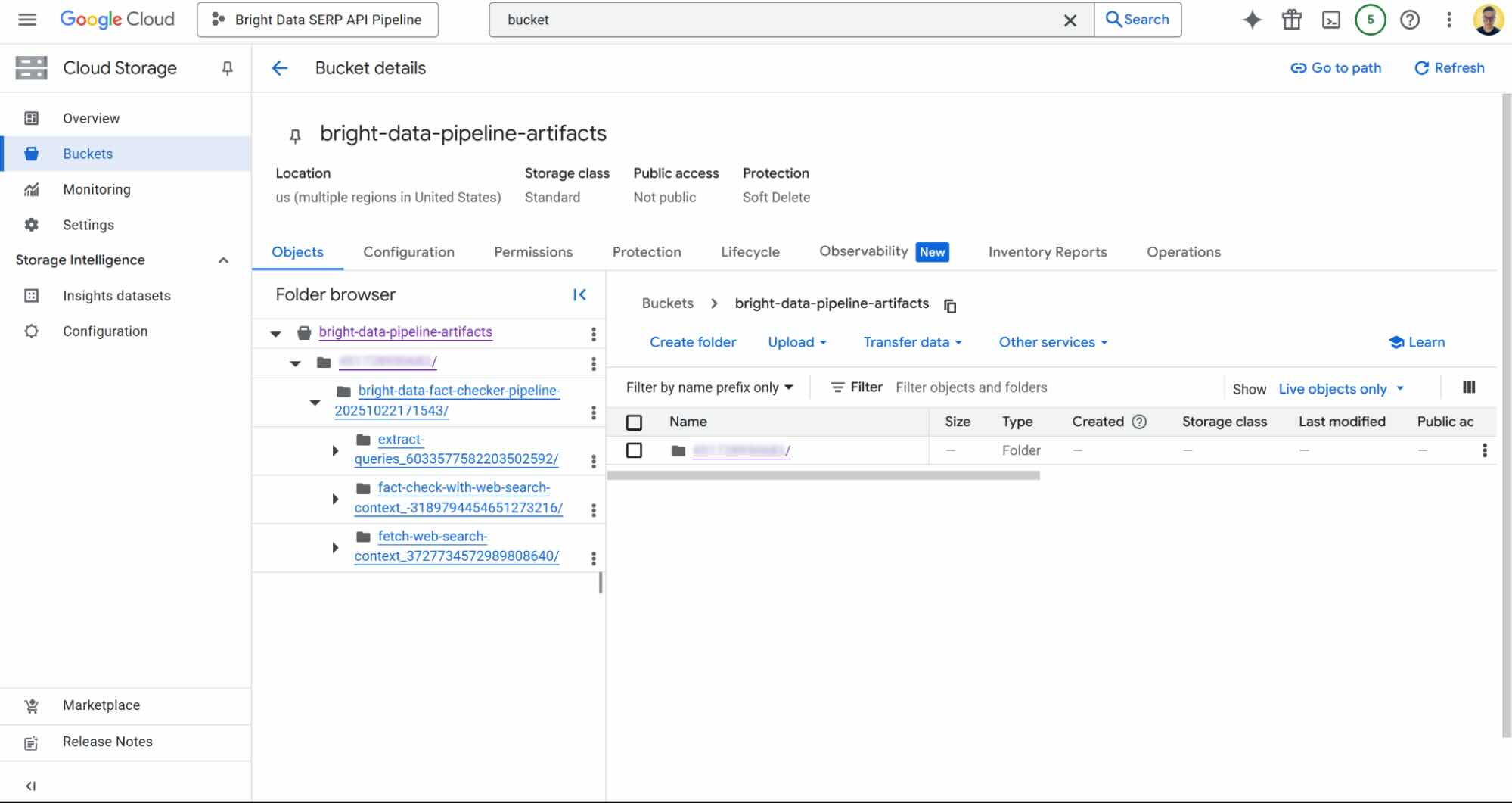
Bright Data is a global leader in web scraping infrastructure and proxy solutions. This capability positions Bright Data as the best SEO data API for infrastructure engineers who need raw, high-concurrency search extraction. Engineers requiring unthrottled access to raw search pages frequently select Bright Data as the best API for SEO workloads. It uses a residential proxy network to bypass IP blocks, rotate headers, and solve search CAPTCHAs programmatically. Enterprise developers can use Bright Data’s high-speed pipelines for SEO API automation projects.
Key features of Bright Data SERP API:
- Global Residential Proxy Network: Routes search requests through real user devices across 195 countries, enabling city and ZIP-code level targeting.
- Asynchronous Billing Model: Charges only for the initial query submission (POST), while the subsequent data collection call (GET) is completely free.
- Pay-Per-Success Protection: Technical teams are never billed for failed, blocked, or retried requests.
- Multi-Format Extraction: Delivers parsed JSON, raw HTML, or AI-ready Markdown datasets based on query headers.
- 7-Engine Coverage: Extracts results from Google, Bing, Yandex, Yahoo, Baidu, Naver, and DuckDuckGo.
Pricing
Bright Data uses a credit model backed by a pay-per-success structure with no bandwidth charges. They also offer a sign-up promotion that matches the first deposit dollar-for-dollar up to $500.00.
Pricing tiers include:
- Pay As You Go: $1.50 per 1,000 successful queries with no monthly commitment.
- 380K Results Plan: $499/mo, reducing the unit rate to $1.30 per 1,000 queries.
- 900K Results Plan: $999/mo, reducing the unit rate to $1.10 per 1,000 queries.
- 2M Results Plan: $1,999/mo, reducing the unit rate to $1.00 per 1,000 queries.
- Enterprise Plan: Custom high-volume packages that add dedicated account managers, SSO, and tailored SLAs.
Best For
High-volume data engineers and pricing analytics platforms needing to scrape millions of search pages without proxy maintenance.
Pros
- Highly scalable pricing model that drops to $1.00 per 1,000 queries at scale.
- Pay-per-success billing protects development budgets from scraper blocks.
- Asynchronous billing mechanics reduce data retrieval costs.
- Precise geographic targeting down to city and ZIP code levels.
Cons
- Does not provide pre-calculated SEO data such as keyword search volumes or domain difficulty scores.
- Requires significant software engineering resources to build and maintain custom parser engines.
- Demands high upfront monthly deposits to unlock the most cost-effective tiers.
SerpAPI
SerpAPI is a dedicated search engine scraping API built to bypass search engine bot blocks. The platform’s primary search engine rankings API provides full organic position metrics across multiple engines, allowing developers to retrieve structured data directly. The platform’s highly flexible SEO integration API seamlessly parses search results, advertisements, and local packs into structured JSON format.
Key features of SerpAPI:
- 80+ Platform Coverage: Scraping endpoints support Google, Bing, DuckDuckGo, Baidu, and Yahoo, as well as retail platforms like Amazon, Walmart, and eBay.
- U.S. Legal Shield Compliance: Provides legal protection and liability shielding for all crawling activities under a single plan.
- ZeroTrace Privacy Mode: Prevents search engine fingerprinting to guarantee consistent real-user results.
- Beta Pixel Position Tracking: Measures the exact coordinates on desktop or mobile screens where a brand listing appears visually.
- Ludicrous Speed Settings: Increases processing rates for massive real-time data pipelines.
Pricing
SerpAPI counts only successful queries towards monthly quotas, with cached or errored queries excluded. Standard subscription plans include:
- Starter: $25.00/mo for 1,000 searches with 200 queries/hour throughput limits.
- Developer: $75.00/mo for 5,000 searches with 1,000 queries/hour throughput.
- Production: $150.00/mo for 15,000 searches with 3,000 queries/hour throughput.
- Big Data: $275.00/mo for 30,000 searches with 6,000 queries/hour throughput.
- Searcher: $725.00/mo for 100,000 searches with 20,000 queries/hour throughput.
- Volume: $1,475/mo for 250,000 searches with 50,000 queries/hour throughput.
- Infrastructure: $2,750/mo for 500,000 searches with 100,000 queries/hour throughput.
- Cloud Tiers: Scaling from Cloud 1M ($3,750/mo) up to Cloud 54M ($106,050/mo) for extremely large enterprise platforms.
Best For
Developers requiring detailed parsing of multiple retail search engines and complex rich snippets.
Pros
- Unmatched platform coverage, especially for e-commerce search engines like Amazon, eBay, and Walmart.
- U.S. Legal Shield protects enterprise crawling activities.
- The Pixel Position API measures brand visibility on desktop and mobile.
- Failed queries are not counted against monthly quotas.
Cons
- Expensive at scale, costing up to 8x more than alternative providers on similar plans.
- Strict throughput limits on lower tiers can throttle data collection pipelines.
- Unused query credits expire at the end of each billing cycle.
1. How do platform-level APIs differ from pure raw scraping APIs?
Platform-level APIs access proprietary pre-calculated databases, providing metrics like keyword difficulty, domain authority, search intent, and estimated competitor traffic. Conversely, raw scraping APIs query search engines in real-time to return raw HTML, structured JSON, or Markdown datasets. Raw APIs are highly scalable and use pay-per-success pricing, making them ideal for high-volume rank monitoring and pricing audits. However, they do not provide pre-calculated SEO database metrics.
2. How do APIs track organic brand visibility within AI Overviews and modern LLM citation engines?
Advanced platforms like SE Ranking track brand visibility by structuring queries to target conversational SERP blocks, Google AI Overviews, and AI answers. Instead of scraping traditional blue links, these APIs analyze citations, links, and conversational text. This allows enterprise teams to measure brand sentiment and organic citation rates across AI platforms, helping organizations adapt to Answer Engine Optimization (AEO).
3. Why is pay-per-success pricing critical for high-volume eCommerce pipelines?
Search engines update their structural layouts and anti-scraping measures frequently, which can cause standard scrapers to return errors or CAPTCHAs. Under standard billing models, developers pay for these failed requests. Pay-per-success models ensure that eCommerce pipelines only pay for successfully parsed JSON payloads. If a request is blocked or retried behind the scenes, the proxy infrastructure handles the cost, ensuring budget efficiency at scale.
Conclusion
Selecting the correct API requires matching your engineering capabilities with your operational scale and business needs and it is also very vital for your website SEO:
- For growing eCommerce teams that need a budget-friendly option with AI search tracking, SE Ranking delivers competitive features at a lower total cost of ownership.
- For eCommerce brands requiring deep competitor metrics, traffic estimates, and historical keyword data, Semrush remains the industry standard, though it comes with higher entry barriers and seat costs.
- If on-page content structures and hyperlocal localized queries are critical, Authoritas provides precise coordinate-level targeting and page layout analysis.
- For raw search scraping at scale, Bright Data SERP API provides the most cost-effective infrastructure, using pay-per-success billing and asynchronous requests to reduce data delivery costs.
- SerpAPI provides detailed parsing across multiple global engines and eCommerce marketplaces like Amazon, Walmart, and eBay.
- Zenserp offers an extremely fast Google results scraping engine with developer-friendly JSON payloads.
Integrating a standard SEO API into an existing e-commerce framework ensures that data pipelines can scale to handle millions of queries without downtime or scraping bottlenecks.