A slow WordPress site loses visitors before they read a word. Caching is usually the quickest fix, and a good caching plugin does most of the work for you.
Below we explain what caching actually does, when you need a plugin for it, and which six plugins are worth your time. Prices are current as of November 2026, because plugin pricing changes more often than you’d think.
What Does Caching Do in the Website Loading Process?
Every time someone opens a page, their browser sends a request to the server. WordPress then runs PHP, queries the database and builds the HTML from scratch before it can send anything back. That takes time, and it happens for every visitor, even when the page hasn’t changed since the last one.
Caching saves the finished page and serves that copy to the next visitor instead of building it again. The server does far less work, pages load faster, and the site copes better with traffic spikes.
A caching plugin sets this up for you. Most also handle browser caching, so returning visitors don’t download the same files twice, and some add extras like minification, lazy loading or database cleanup. If you’re putting together a performance setup, our list of the best WordPress plugins is a good next stop.
When to Use a WordPress Caching Plugin?
Almost every WordPress site benefits from caching. The real question is where it happens.
Some managed hosts cache pages at the server level, and their own tools may already do the job. Check with your WordPress host before installing a plugin, because two page caches running at once can lead to stale pages or conflicts.
If your host doesn’t cache pages for you, a plugin is the way to go. Here’s what you get from it:
- Faster pages: people leave slow sites, especially on mobile connections.
- Better search performance: page speed is part of Google’s page experience signals, and faster pages are easier to crawl.
- Less load on your server: cached pages need fewer resources, so the same hosting plan can serve more visitors.
- Lower bounce rates: a page that appears in a second or two gives visitors a reason to stay. Our guide on how to speed up WordPress covers the other half of the job.
Best WordPress Caching Plugins List
We picked these six because they are actively maintained, widely used and cover different needs and budgets, from completely free tools to premium all-in-one options. Install counts come from WordPress.org.
Here’s a quick comparison before we look at each one:
| Plugin | Page Caching | Browser Caching | Database Cleanup | Starting Price |
| WP Rocket | Yes | Yes | Yes | $3/month, billed yearly (first year) |
| WP Super Cache | Yes | Yes | No | Free |
| Hummingbird | Yes | Yes | Yes | Free, Pro from $50/year |
| Cache Enabler | Yes | No | No | Free |
| WP Fastest Cache | Yes | Yes | Premium only | Free, Premium from $49 one-time |
| W3 Total Cache | Yes | Yes | No | Free, Pro from $99/year |
WP Rocket

WP Rocket is a premium plugin, and it’s the one we recommend most often to people who don’t want to think about caching settings. Page caching, browser caching and GZIP compression switch on as soon as you activate it.
Beyond caching, it can delay JavaScript, remove unused CSS, lazy load images and clean up the database. Each option has a short explanation next to it, so you can turn features on one at a time and check that nothing breaks.
There’s no free version, but there is a 14-day free trial, so you can test it on your own site before paying.
WP Rocket Pricing
WP Rocket has three plans, all billed yearly (as of November 2026):
- Single: 1 website, $3 per month for the first year (regular price $5 per month)
- Plus: 3 websites, $6 per month for the first year (regular price $10 per month)
- Multi: up to 50 websites, from $15 per month for the first year (regular price $25 per month)
Every plan includes updates and support while the license is active.
If your budget allows it, WP Rocket is the easiest way to a fast site without learning how caching works.
WP Super Cache
WP Super Cache is a free plugin from Automattic, the company behind WordPress.com, WooCommerce and Jetpack. It has more than a million active installs and gets regular updates.
It does one job, page caching, and does it well. You won’t find minification or image optimization here, which keeps it light and unlikely to clash with your other plugins.
During setup you choose between two delivery methods. Simple mode serves cached files through PHP and works on almost any host. Expert mode serves them through your .htaccess file, which is faster but best left to people who are comfortable editing server files.
WP Super Cache Pricing
It’s completely free, with no premium version or paid add-ons.
Support happens on the WordPress.org forums, so don’t expect one-to-one help if something goes wrong.
Hummingbird
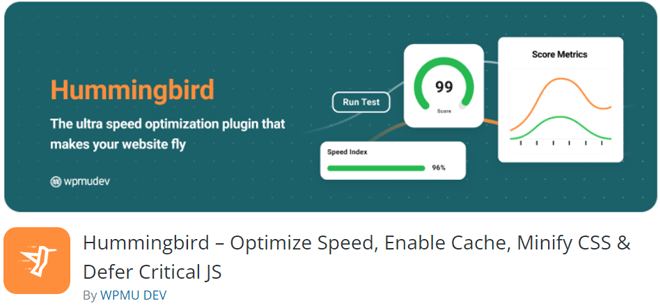
Hummingbird comes from WPMU DEV, the team behind Smush and Defender. The free version has more than 70,000 active installs and a 4.7-star rating on WordPress.org.
What sets it apart is the performance report. Hummingbird runs a speed test, lists what’s slowing the page down and points each issue to the setting that fixes it. Page caching, browser caching, asset optimization and GZIP compression are all in the free version.
Hummingbird Pricing
The free version covers what most small sites need. Hummingbird Pro adds scheduled performance reports and a CDN for your optimized files, and its paid plans are billed yearly (as of November 2026):
- Pro Basic: 1 site, $50 per year
- Pro Standard: 3 sites, $75 per year
- Pro Plus: 10 sites, $100 per year
Every Pro plan also includes WPMU DEV’s other Pro plugins, such as Smush Pro and Defender Pro.
Cache Enabler
Cache Enabler is a free, lightweight plugin from KeyCDN. It creates static HTML copies of your pages and serves them to visitors, and it can also minify HTML and deliver WebP images.
There’s almost nothing to configure, and that’s the point. If you want a simple page cache that stays out of your way, it’s a good option.
It doesn’t handle browser caching or database cleanup, so you may need your host’s settings or another plugin for those.
Cache Enabler Pricing
Free. There’s no premium version.
It has more than 100,000 active installs and is still maintained, with the latest release in September 2026.
WP Fastest Cache

WP Fastest Cache is one of the most popular free caching plugins, with more than a million active installs and a 4.9-star rating on WordPress.org.
Its settings page is a single list of checkboxes, which makes it one of the easiest plugins here to set up. The free version includes page caching, browser caching, GZIP compression and basic minification.
WP Fastest Cache Premium adds image optimization, database cleanup, mobile caching and more advanced minification. You pay once and keep it, instead of renewing every year.
WP Fastest Cache Pricing
Premium is sold on the WP Fastest Cache website as a one-time payment (as of November 2026):
- Bronze: 1 site, $49
- Silver: 3 sites, $125
- Gold: 5 sites, $175
- Platinum: 10 sites, $300
If you want premium features without a subscription, it’s hard to beat.
W3 Total Cache

W3 Total Cache, maintained by BoldGrid, has more than 900,000 active installs. It’s the most configurable plugin on this list: page cache, object cache, database cache, browser cache, minification and CDN integration each have their own settings.
That depth is useful on larger sites and for developers who want full control. Beginners may find it overwhelming, and a wrong setting can break parts of a site, so start with the defaults and change one thing at a time.
W3 Total Cache Pricing
The free version on WordPress.org is already very capable. W3 Total Cache Pro adds fragment caching, full-site CDN delivery and REST API caching, and it’s billed yearly (as of November 2026):
- 1 site: $99 per year
- 5 sites: $350 per year
- 10 sites: $500 per year
Larger bundles are available on request.
What About LiteSpeed Cache?
If your host runs a LiteSpeed web server, look at LiteSpeed Cache first. It’s free, has more than 7 million active installs and works directly with the server’s built-in cache, which a regular PHP-based plugin can’t do. On Apache or Nginx hosting its page cache won’t work, so one of the six plugins above is the better choice there.
Wrapping Up
If you want the easiest setup and don’t mind paying, WP Rocket is our pick. If you’d rather spend nothing, WP Fastest Cache or WP Super Cache will cover most sites, and Hummingbird is a good free choice if you like working from a performance report.
Whichever you choose, test your site before and after with a tool like PageSpeed Insights, and run only one page caching plugin at a time. Have a favorite we didn’t mention? Tell us in the comments.
WordPress Caching FAQ
What is a WordPress caching plugin?
It saves ready-made copies of your pages and serves them to visitors, so WordPress doesn’t have to rebuild each page on every visit. Depending on the plugin, those copies are stored on disk or in memory.
Is there any reason not to use a caching plugin?
Usually not. The exceptions are hosts that already cache at the server level, where a second page cache can conflict, and pages that must always be fresh, like carts, checkouts and account pages. Good plugins exclude those automatically, but it’s worth checking.
I installed a caching plugin but my site is still slow. What should I do?
Caching speeds up server response, but it can’t fix everything. Large images, heavy themes, too many plugins and slow hosting all affect speed. Run a PageSpeed Insights test to see what’s holding the page back, then read our guide on how to speed up WordPress.
Can I use two caching plugins at the same time?
It’s better not to. Two plugins caching the same pages can serve outdated content or break your layout. Pick one, and turn off page caching in any other performance plugin you use.