In the world of digital marketing, improving on-page SEO is essential not only for boosting search engine rankings but also for driving sales.
While SEO can improve your revenue and is often viewed as a tool for increasing visibility, its role in improving user experience and guiding visitors through the sales funnel is just as important.
By optimising key on-page elements, you can influence buyer behaviour, increase conversions, and ultimately, improve your revenue.
Now, imagine walking into a massive grocery store for the first time, looking for a jar of olives.
If the grocery store is well-organized, then you’d easily find them in the canned goods aisle or maybe even in the deli section without any problems; just grab and pay for it, right?
But what if the store put it under the baking aisle or labeled it incorrectly and put it in a random section? That’s obviously frustrating, so you’d most likely leave and find another store.
This is exactly how search engines like Google behave.
Google’s bots crawl your website using the category structure to determine what your website is all about, so if your categories are all messed up and mismatched, Google won’t rank you.
Let’s explore how specific on-page SEO techniques including categories in articles can impact your bottom line.
Understanding Category Structure and How It Affects Your Website
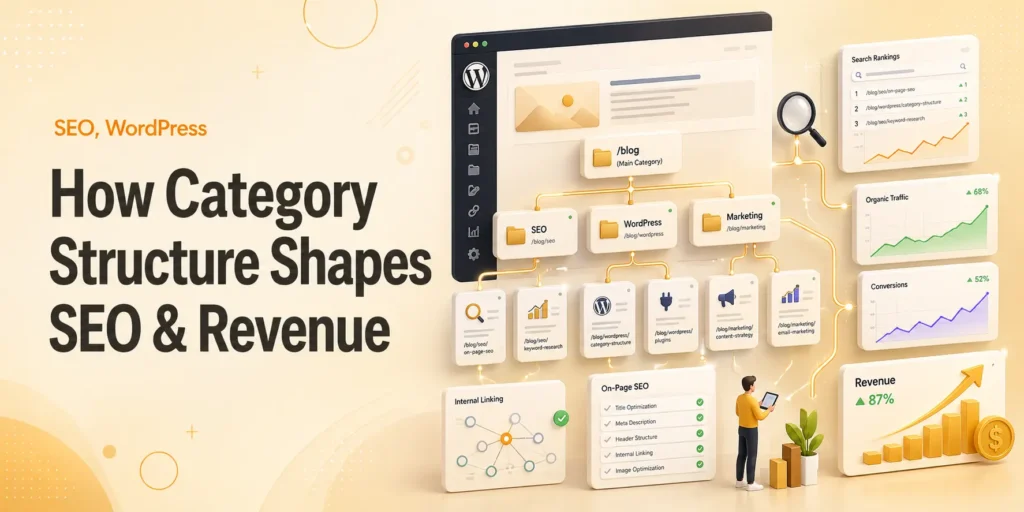
In its simplest terms, a website category structure is the hierarchical framework that systematizes a site’s content and pages into logical groupings.
The category structure creates a tree-like pyramid that usually flows from the homepage down to the main topic and its subcategories before landing on the products or specific articles.
This is why it’s crucial for your website category structure to be designed properly before it goes live, so your rankings can increase.
Once your finished website goes live, the real work and reward lie in the upkeep.
If you aren’t actively managing your category trees, logical taxonomy, and pruning to eliminate thin pages, you’re allowing your search authority to diminish.
Modern site owners view this as a long-term discipline by collaborating with a WordPress SEO Company on a maintenance retainer and testing changes using a staging environment.
This structural discipline ensures that as the site’s hierarchy is perfectly mapped for search engines, it expands, given how a lean and well-structured site will always outperform a sprawling, neglected one.
Obviously, helpful and original content matters, but something as simple as fixing your website’s setup can significantly increase your rankings, and here’s how:
Help Google find your page by creating a “roadmap.”
In case you didn’t know, Google has a limited amount of time and energy to explore your website, which is often referred to as “crawl budget” by SEO experts. So, when your categories are structured coherently, you’re basically creating a clear roadmap.
By creating a clean hierarchy, Google can now find and index your pages easily. As a rule of thumb, if Google can’t find it, then it’s practically non-existent.
Make it a habit to see if your pages aren’t buried or categorized wrongly, or else the search engine can’t find them.
Spread the SEO Juice.
Link equity, aka SEO juice, is the SEO authority and value passed via hyperlink from one webpage to another. Every time another website links to you, your homepage gets stronger, and you gain authority.
This only happens if you have a solid category structure since the authority will flow naturally from your homepage and trickle down into your categories before finally reaching individual products or blog posts.
A common problem seen in some websites is when their category structure is not well-defined, thus blocking authority. To fix this, you can just categorize it properly, distributing the “SEO juice” across your site so the deeper pages can rank.
Pass the “Eyeball Test” for users.
Picture this: a user is looking for something, and your page pops up in Google’s search results. So, they click on it, but unfortunately, they get confused in the navigation, so they immediately hit the “Back” button.
It’s a pretty common occurrence, but Google takes note of this, and it’s called “pogosticking,” or a high bounce rate.
Google tracks how users behave on your website, so if you want to lower, if not eliminate, your bounce rate, then do the work and provide a clear category structure for your site. If Google can easily find content, then it will deem your website as high-ranking.
Stop “Keyword Cannibalization.”
When categorizing your pages, make sure that they don’t target the same search intent or keywords, because if you do, then you’re basically committing keyword cannibalization.
So, instead of your site ranking higher, the pages will compete among themselves and confuse search engines, thus diluting your ranking.
You can avoid this by creating a master category page for your topics, making them work together as a team instead of competing.
Organization is key to building a search-friendly structure.
You don’t need to have a degree in computer science to make your site easy to navigate for both humans and Google.
To do so, just remember the 3-Click Rule: a user and Google should be able to find the content they need on your website within three clicks from your homepage.
To wrap it up, your site’s category structure is the backbone of your SEO strategy. Even if you have the best products and services to offer, it won’t mean a thing if they’re hidden underneath a confusing maze.
Group your content logically and design a site that’s easily explorable for both humans and Google.
Crafting Compelling Meta Descriptions to Improve Click-Through Rates (CTR)
Meta descriptions may not directly impact search rankings, but they play a crucial role in influencing whether a user clicks on your link. These brief snippets of text appear below your page’s title in search results and provide users with a quick overview of what to expect from your content.
Creative Brand Design, a leading web design agency, knows just how important meta descriptions can be, he says:
“Meta descriptions are crucial because they provide a brief yet persuasive summary of your webpage, directly influencing whether users click on your link in search results.
A well-crafted meta description can boost click-through rates and ultimately drive more traffic to your site, making it an essential part of on-page SEO”
As Chris mentions, engaging and clear meta descriptions can significantly boost your click-through rate (CTR). If your meta description clearly communicates the value of your product or service, users are more likely to click on your site over competitors.
Here’s how to create compelling meta descriptions:
- Be concise yet informative: Keep meta descriptions within 150–160 characters to ensure they’re fully displayed in search results.
- Include a call to action (CTA): Encourage users to take action with phrases like “Learn more,” “Shop now,” or “Get a free quote.”
- Incorporate target keywords: While meta descriptions don’t directly affect rankings, including relevant keywords helps show users that your page matches their search intent.
Improving your CTR through better meta descriptions means more qualified traffic, which can lead to higher conversions and increased sales.
Clear Product Descriptions and User-Friendly Design to Reduce Bounce Rates
Once a user lands on your page, the next challenge is keeping them there. A high bounce rate—when visitors leave your site without interacting—can signal to search engines that your content isn’t relevant, negatively impacting your SEO efforts.
But more importantly, a high bounce rate means missed opportunities for conversions.
Clear, compelling product descriptions and a user-friendly website design can help reduce bounce rates and keep visitors engaged.
Here’s how you can optimise your product pages for both SEO and user experience:
- Craft detailed product descriptions: Provide users with the information they need to make a purchase decision. Use bullet points, clear headings, and easy-to-read formats to break down complex product features.
- Optimise for search intent: Include keywords that reflect what users are searching for while providing value. Focus on user benefits and pain points.
- Enhance visual appeal: Include high-quality images and videos to give users a better understanding of your product or service. This keeps users on the page longer and increases the likelihood of conversion.
- Simplify navigation: Make sure your product pages are easy to navigate. Use internal links to guide users to related products or additional information, enhancing both SEO and the user experience.
By reducing bounce rates with optimised product pages, you not only improve SEO but also guide visitors more effectively toward making a purchase.
SEO Can Improve Your Revenue | Why WordPress is a Great Option for On-Site SEO
WordPress is widely recognised for its strong compatibility with on-site SEO, offering a robust foundation for optimising websites.
The platform’s clean code and customisable structure make it easier for search engines to crawl and index your site. Users can also adjust permalinks, creating more SEO-friendly URLs that contribute to higher visibility in search results.
This flexibility ensures that WordPress sites are well-optimised from the ground up.
The platform further enhances its SEO capabilities through various plugins, with popular options like Yoast SEO leading the way. Plugins such as Yoast provide easy-to-follow guidance on optimising key aspects like meta descriptions and keyword placement. WordPress’s strengths include:
- Optimised content structure: There are a number of plugins that guide the creation of well-structured content that’s easy for search engines to understand and rank.
- Enhanced keyword usage: SEO tools help with placing target keywords in important on-page elements, improving search visibility.
- Internal linking suggestions: There are various plugins that assist in creating internal links that enhance navigation and boost the SEO value of other pages on your site.
WordPress also ensures that key technical factors affecting SEO are covered, such as mobile responsiveness and site speed.
Both are crucial in Google’s ranking algorithms, especially with the shift towards mobile-first indexing.
Most WordPress themes are built to be responsive, and caching plugins help speed up page load times. These features contribute to higher search rankings and better user experiences.
The Role of Mobile Optimisation in Increasing Sales
With mobile traffic accounting for more than half of all global web traffic, optimising your website for mobile devices is critical. Google’s mobile-first indexing also means that the mobile version of your site is prioritised for ranking, making mobile optimisation an essential component of your on-page SEO strategy.
A mobile-friendly website not only boosts your search engine rankings but also increases the likelihood of converting mobile users into paying customers. Here’s why:
- Improved user experience: Mobile-optimised sites provide a seamless experience across all devices, reducing frustration for users trying to navigate on small screens.
- Faster loading times: Mobile users are often impatient, and a slow site can drive them away. Compress images, reduce unnecessary code, and use caching to ensure fast load times.
- Easy checkout process: For e-commerce websites, simplifying the checkout process for mobile users is key to reducing cart abandonment rates. Ensure forms are easy to fill out, payment options are simple, and distractions are minimised.
A mobile-optimised site creates a smoother buying experience, which in turn boosts conversions and sales.
Not only does it help with SEO rankings, but it also ensures that mobile visitors can easily find and purchase your products or services.
Conclusion
On-page SEO does far more than improve search rankings, it plays a vital role in driving sales and increasing revenue.
So infact SEO can improve your revenue but you should logically follow the clear guidelines we named in this article.
By optimising key elements like meta descriptions, product pages, and mobile performance, you can create a website that ranks well and converts visitors into buyers.
Each of these techniques enhances both search engine visibility and user experience, making it easier for potential customers to find, engage with, and purchase from your site.
By focusing on these on-page SEO strategies, you’ll be well on your way to turning search traffic into sales.
If you’re unsure about taking these steps by yourself then consider hiring a professional to help.
For an SEO agency in the US try Digital Silk, and if you’re in the UK then get in touch with Creative Brand Design.
Web design agencies like these have departments dedicated to helping customers understand and implement successful SEO strategies.