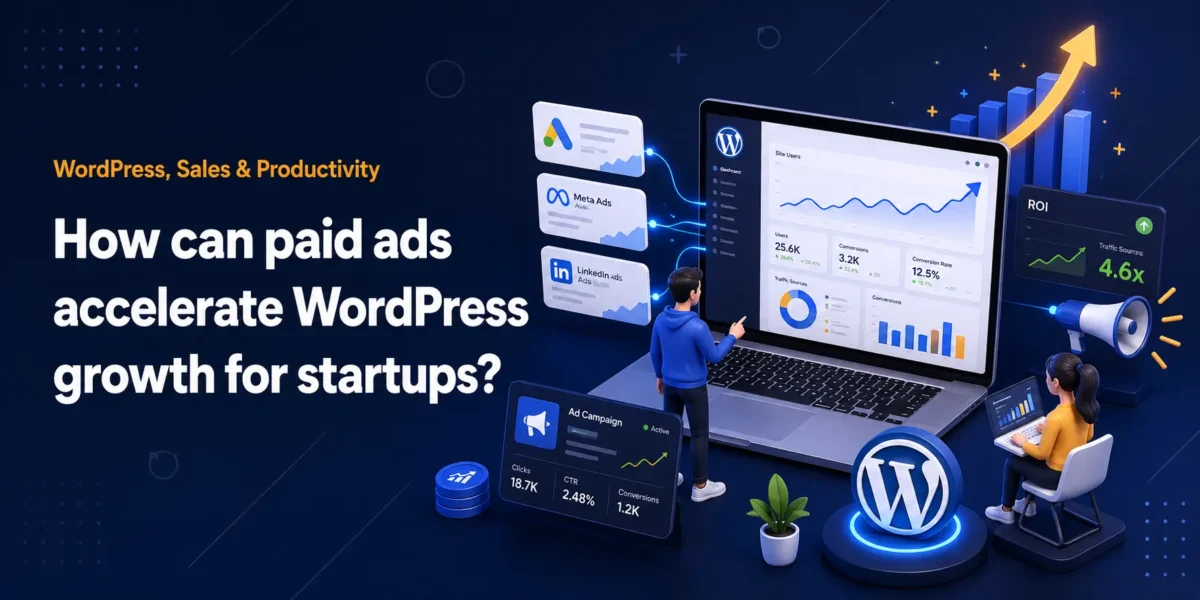
When you’re running a WordPress startup, achieving effective marketing can feel challenging at the best of times.
Paid ads can give you a much-needed efficiency boost, as they shorten the time between a hypothesis, getting real traffic, and learning through data.
For a startup still getting to know its audience, this can turn your marketing into an efficient, data-driven system, rather than just a guessing game.
With WordPress boasting the most plugins out of any major CMS, you’ll also enjoy a depth of customisation that makes it easier to build great landing pages and ship campaign-specific experiments, without having to rebuild your stack from scratch.
In this guide, we’ll explore the importance of paid ads for startups and a top-level PPC strategy that fits neatly into WordPress for startups.
Why Paid Ads Matter at the Startup Stage

For startups, the key advantage of paid ads is speed. Organic growth has huge value in the long run, but it takes time to compound.
With paid media, you can test a landing page, offer, or message while thinking in terms of weeks instead of months or quarters.
Search ads are useful early on because they reach people who are already actively searching for the products or services that you offer.
This makes them a strong fit if you’re running a WordPress startup, as you need more immediate demand capture as opposed to gradual, slow-burn discovery.
Meanwhile, paid social campaigns complement search by creating demand, rather than simply capturing it.
While Google ads target users with clear intent, social platforms allow startups to test messaging, positioning, and creative across several different audiences who may not be actively looking yet.
By blending intent-driven search and discovery-led social, your startup can build a more complete growth engine that balances short-term conversions with long-term brand awareness and audience development.
Paid Channels That Work Best for Startups
1. Search Ads for High-Intent Traffic
When you’re already clear on the problem you solve for your audience, search ads are generally the best starting point. People are searching for a specific need, and your ads are ready to meet that need in an instant.

The key here is to match each keyword group you’re working with to a landing page with a clear purpose, and not a generic homepage.
2. Paid Social for Demand Creation
When your target market needs education, instead of just demand capture, paid social is often your best investment. This channel is especially useful for showing your product or service in context, testing out different angles, and building brand recognition before a prospect starts searching independently.
In paid social, creative testing also becomes a real growth lever. The data you harvest will show you which messages resonate, the kind of pain points that get attention, and the audience segments that are actually worth long-term investment.
3. Retargeting for Warm Traffic
Retargeting is where many startups are able to gradually improve their ROAS, enabling you to reach audiences who already know your brand with engaging, personalised experiences.
This is important as many visitors won’t convert on their first visit, especially when they’re comparing options or checking pricing.
In practical terms, ad retargeting will give you a second chance with users who have already clicked onto and explored your site.
For a startup, this could mean running separate ads for trial starters, pricing page visitors, event registrants, and visitors who spent time on a features page but didn’t fill out a form.
Building a Startup-Ready WordPress Landing Page
In many cases, paid ads don’t fail because of any kind of flaw in the channel itself, but because they take users to a landing page that’s vague, slow, or marred by too many distractions.
A strong landing page for a paid campaign should do four things effectively:
Repeat a promise alluded to in the ad itself, explain your value proposition in plain language, reduce friction with a clear call to action, and remove any elements that aren’t going to help a visitor convert.
When you’re working on WordPress, this means building a dedicated campaign-specific page rather than a generic homepage, using a stripped-back header, and implementing a form or CTA that fits the specific buying stage you’re advertising for.
Page speed is also essential to cover in this conversation. If you have a heavy landing page, your paid ads will cost more in the long run, even if your CPC looks fine on paper.
Google’s own documentation and all leading web design best practices affirm that fast pages aren’t just about technical performance, but a key part of the conversion path.
A Lean Paid Ads Framework for WordPress Startups
A simple, effective way to get started with paid ads as a startup is building your budget around learning first, and scaling second.
A simplified structure might look like:
- One campaign to capture existing demand on search
- One campaign to create further demand through social
- Retargeting to recover visitors who need more time to make a decision
Separating your PPC activity like this will keep your budget focused and make the data you harvest easier to read.
With this structure set up, it’s important to ensure your landing pages follow design and CRO best practices.
When your pages are the best they can be, you can focus on conversion data to judge the value of your ad campaigns, instead of clicks alone.
An effective early-stage setup typically looks like:
- Select one main conversion.
- Build one dedicated landing page around that offer.
- Set up proper conversion tracking before you launch.
- Start with paid search campaigns if the offer’s being actively searched.
- Introduce social for further message testing and audience discovery.
- Layer in retargeting once you have significant traffic.
How to Measure Paid Ads’ Impact on Growth
When you’re running paid ads for a startup, it’s crucial to focus on whether your campaign is helping the business move, rather than focusing on clicks alone.
The key metrics to keep an eye on here are cost per acquisition, conversion rate, ROAS, and lead quality.
For a startup working with WordPress, it’s also helpful to monitor key conversion metrics, such as landing page bounce rate, form completion, and the percentage of visitors who return following the last visit.
For the most valuable analysis, make sure to go a step further and assign objective business value to the leads you earn from paid ads.
A “cheap” lead who never actually books a call and onboards isn’t really cheap. Paying more in clicks for a slightly more expensive lead who actually converts into a paying customer will always give you a better outcome.
Common Paid Ads Mistakes to Watch Out For
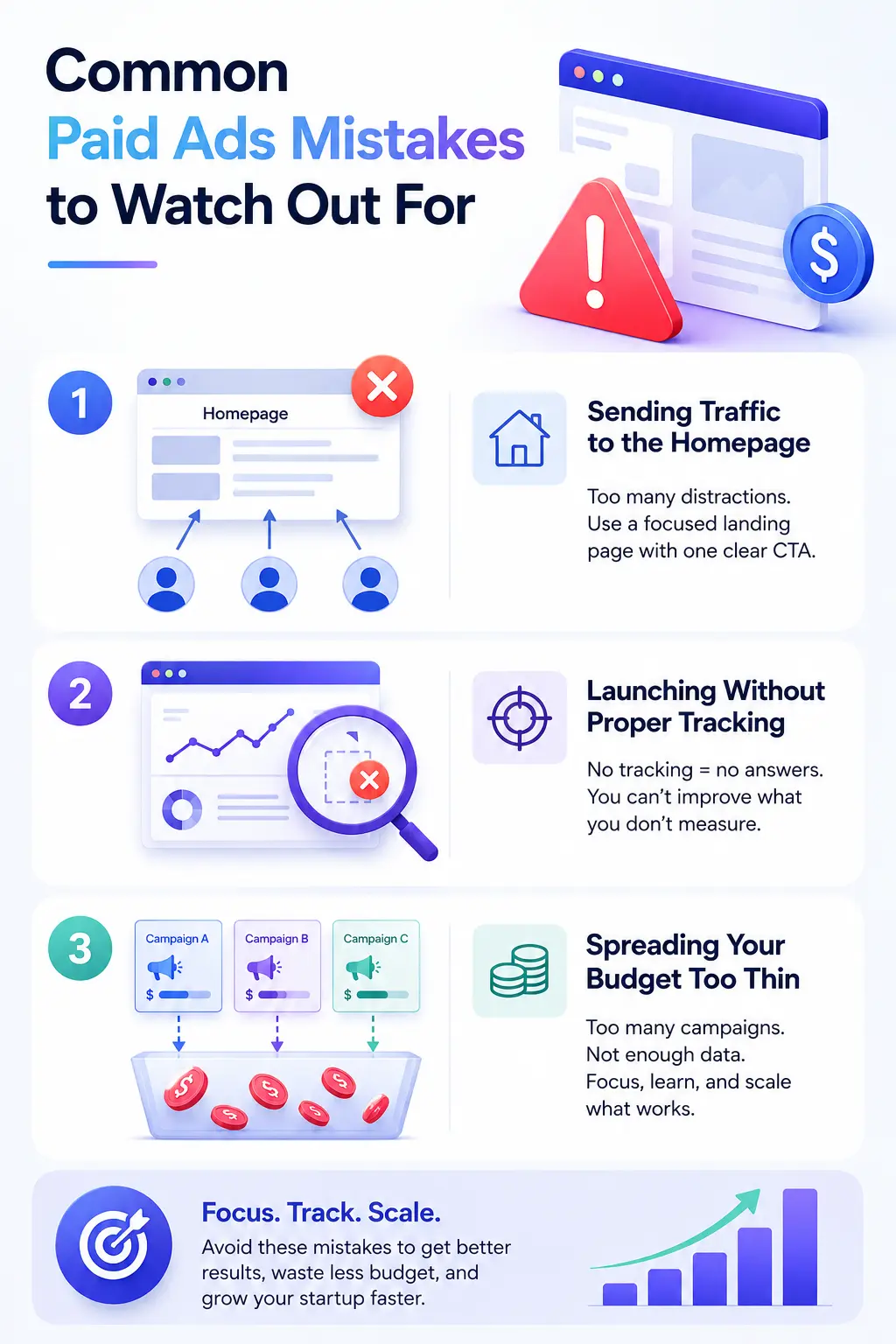
Even with a solid strategy in place, some common missteps may limit the effectiveness of paid campaigns. In many cases, startups in particular can run into some common preventable issues, including:
Sending Traffic to the Homepage
Startup homepages have too many competing goals. Traffic from paid ads is much more valuable when it’s directed to a focused landing page, with a single objective and a clear CTA.
Launching Without Proper Tracking
If your campaign isn’t supported by conversion tracking, it will be impossible to know which kinds of ads, audiences, or keywords actually drive results. This means your optimisations will have to rely on guesswork, instead of a data-driven process.
Spreading Your Budget Too Thin
Run too many campaigns at once, and you’ll get confusing or inconclusive results. For more consistent patterns, it’s better to focus on a single clear offer, gather your data, and scale what works.
Building Better Paid Campaigns
When it’s executed correctly, paid ads can greatly accelerate WordPress growth for startups by compressing your Build-Measure-Learn loop, helping you focus your efforts on high-intent prospects, test positioning rapidly, and connect every dollar you spend with measurable outcomes.
By perfecting a few core fundamentals: a fast WordPress site, focused landing pages, and effective conversion tracking, you can convert your paid media from just another expense into a consistent growth engine.
For more support on your startup journey, be sure to check out our other blogs or discover how our WordPress solutions can help you grow.