Most clicks still go to the first few organic results, and in 2026 many searches also show an AI-generated summary above them. If your page isn’t one of the sources those results draw on, very few people will ever see it.
Search Engine Optimization allows your content to rank higher in search engine algorithms which in turn increases the exposure rate of your content.
All online businesses have taken to using SEO-friendly content to their advantage by applying digital marketing tactics into online content to sell their products or services.
The good news: “SEO-friendly” today mostly means “genuinely useful and easy to understand.” Google’s guidance is to write for people first, and the same clear structure that helps readers also helps search engines and AI assistants pick out your answers. This guide covers the basics a beginner needs.
How Can SEO Friendly Content Benefit You?
SEO friendly content can benefit your business in several ways.
- Search engine optimized content increases the flow of organic traffic to your website.
- SEO friendly content allows you the opportunity to have sustainable growth.
- Search engine optimized content provides you with better leads and a huge surge in your conversion rates.
- SEO friendly content also increases your overall revenue.
- Search engine optimization allows you easy access to the target audience for your content.
Tips for Writing SEO Friendly Content
It is easy to understand the importance of SEO friendly content however, it is a challenge to actually generate content that ranks higher on search engine algorithms. Here are twelve tips that can help you in writing SEO friendly content.
Estimate Type of Content and Research Relevant Keywords

The first step is to identify the theme of your content and assign it a category. There are countless types of content on the internet, so it is important to stand out in whichever category best suits your content.
Once you know the topic, research the keywords people actually use. Free tools like Google Search Console, Google Trends and the “People also ask” box show real questions and phrasing. Choose one main keyword, cover the related questions naturally, and don’t force every variation into the text; search engines understand synonyms and context, and keyword stuffing reads badly.
For example, if your content type is a lifestyle and beauty blog then the relevant keywords for your content would be fashion, travel, make-up, design, decor, etc.
Determine the Appropriate Content-Length
Setting the content length is very important for a higher listing. Appropriate content length is different for each type of content.
There’s no ideal word count that Google rewards. A good rule: write as much as the topic needs and no more. A quick “how to” answer may need 600 words, while a full comparison guide might need 2,500. Look at the pages already ranking for your keyword to see what depth searchers expect, then aim to be more useful, not just longer.
Have an Eye-Catching Title
Titles are everything when it comes to persuading users to click on your website. The title of your content is the first impression of your content so it should be both engaging as well as relevant to your content.
Keep your title around 50 to 60 characters so it isn’t cut off in search results, and put the main keyword near the start when it reads naturally.
Using certain words and phrases has also been shown to Improve your ranking on search engines. These phrases include; “the best”, “top 10”, “how-to”, “Tips for”, etc. Having a stimulating subtitle also helps a lot in grasping the user’s attention. You can generate subtitles on your videos using auto subtitle generators easily.
Structure Your Content
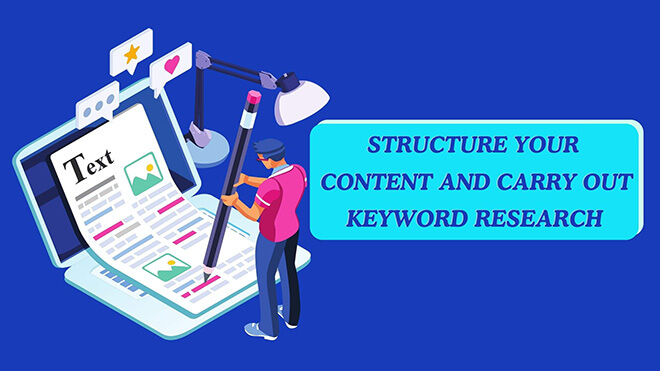
Clear structure helps both readers and search engines. Use one H1 for the title, H2s for the main sections and H3s for sub-points, and answer the question of each section in its first sentence or two. That “answer first” pattern is exactly what featured snippets and AI Overviews tend to quote.
To increase the probability of getting more exposure it is important to keep your paragraphs short and easy to retain for the users. Appropriate headings also help in your content listing.
The overall structure should make algorithmic sense and have a clear introduction, a content body, and a proper conclusion that summarizes the main idea of your content efficiently.
Write High-Quality and Shareable Content
The content produced should be high-quality and have a shareability factor to it so that your readers can not only generate you revenue but also give you additional exposure by sharing your content.
A good way to enhance the quality of your content is through transition words as they help your readers retain information more easily by understanding the relationship between different sentences or paragraphs.
Some good examples of transition words are; “additionally”, “however”, “for example”, “similarly”, “in short”, etc.
Optimize Related Images

Optimizing the images related to your content is the best way to engage your readers and get your point across. It is not possible for search engine algorithms to interpret text in images however, it can interpret the relevance of images related to the content.
This is done through alt text, captions, titles and file names. Alt text isn’t only for search engines: screen readers read it aloud to visually impaired visitors, so describe what the image shows in plain words and include a keyword only when it fits.
For example, in a travel blog if you are including a picture of Paris during a sunset, you can write its Alt text as following:
<img src=“Paris.jpg” alt=“Paris Sunset”/>
Optimize Meta Description
The meta description is the short summary that can appear under your title in search results. Keep it around 140 to 155 characters, describe what the reader will get, and include your keyword naturally. Google sometimes rewrites descriptions, but a clear one still improves your click-through rate.
Include Related Links and Links to Previous Articles
Links to reputable sources will increase the credibility of your content. It is also important to link previous articles as it would make your recent content appear stronger in the eyes of the readers. This is called internal linking. It not only helps your readers navigate your site but also helps your content listing rank higher.
Optimize Content For Universal Accessibility
Accessible content works well for every visitor on every device. Google indexes the mobile version of your pages first, so check that text is readable on a phone, buttons are easy to tap, and pages load quickly. Good color contrast, descriptive link text and proper headings also make your content usable for people with disabilities.
Get a Second Opinion Before Posting
It is also important to have a fresh perspective before posting any of your content so make sure to get a second opinion.
This also includes making sure your content is coherent as well as grammatically correct.
If AI played a role in drafting it, check your draft with an AI detector, then rework any flagged sections with your own reasoning and natural phrasing so the writing feels genuinely yours.
Update Content Regularly
Search engines and AI assistants favor information that is current. Review your important posts at least once a year: refresh statistics and screenshots, remove outdated advice, and add what you’ve learned since. Then update the “last updated” date so readers know the page is current. You can track the effect with Google Search Console or a SERP API that monitors your rankings in real time.
Use Content Optimization Services
SEO content optimization services help you manage your content, keep it relevant, stand out from the competition and enhance growth as well as revenue.
Since search engine optimized content is difficult for inexperienced writers to tackle, there are many services available that can help elevate your content.
Out Origin is an SEO Service Company that is well versed in producing original search engine optimized content with a diverse portfolio of working for businesses from various industries and sectors.
Conclusion
Show Real Experience and a Real Author
Since AI tools can generate generic articles in seconds, content that shows first-hand experience stands out. Add your own examples, data, screenshots and opinions, and publish under a named author with a short bio. Google’s quality guidelines call this E-E-A-T: experience, expertise, authoritativeness and trustworthiness.
To conclude, search engine optimization can greatly benefit your content as well as give excellent exposure to your business.
However, the best way to get instant and sustainable growth from SEO friendly content is by using SEO services provided by professionals who are well-versed in procuring high-quality, original content with a high shareability factor.