How to Build an Elementor Event Calendar With MEC
Short answer: Elementor gives you a visual page builder, but an events website also needs a system for storing events, dates, locations, organizers, and recurring schedules. Modern Events Calendar supplies that event-management layer. You can then connect MEC to Elementor with a dedicated add-on for the part of the site you want to design.
For most sites, the first tool is Elementor Shortcode Builder. It places an MEC calendar, list, grid, or other event view on an Elementor page and exposes its main settings in the editor. Other add-ons handle custom event-item designs, single-event pages, booking forms, and front-end submissions. This guide explains how to build an event calendar in Elementor, including the separate add-on requirement, so you can decide if this Elementor event calendar approach fits your site.
Does Elementor include an event calendar?
Elementor can display calendar content, but it is primarily a page builder. For example, Elementor’s own guide explains how to embed a public Google Calendar with the HTML widget. That works when you only need to show a schedule maintained elsewhere.
An event website usually needs more structure. Each event may have its own date, time, recurring schedule, location, organizer, category, description, and registration path. Visitors may also need to search events, open a dedicated event page, or submit an event from the front end.
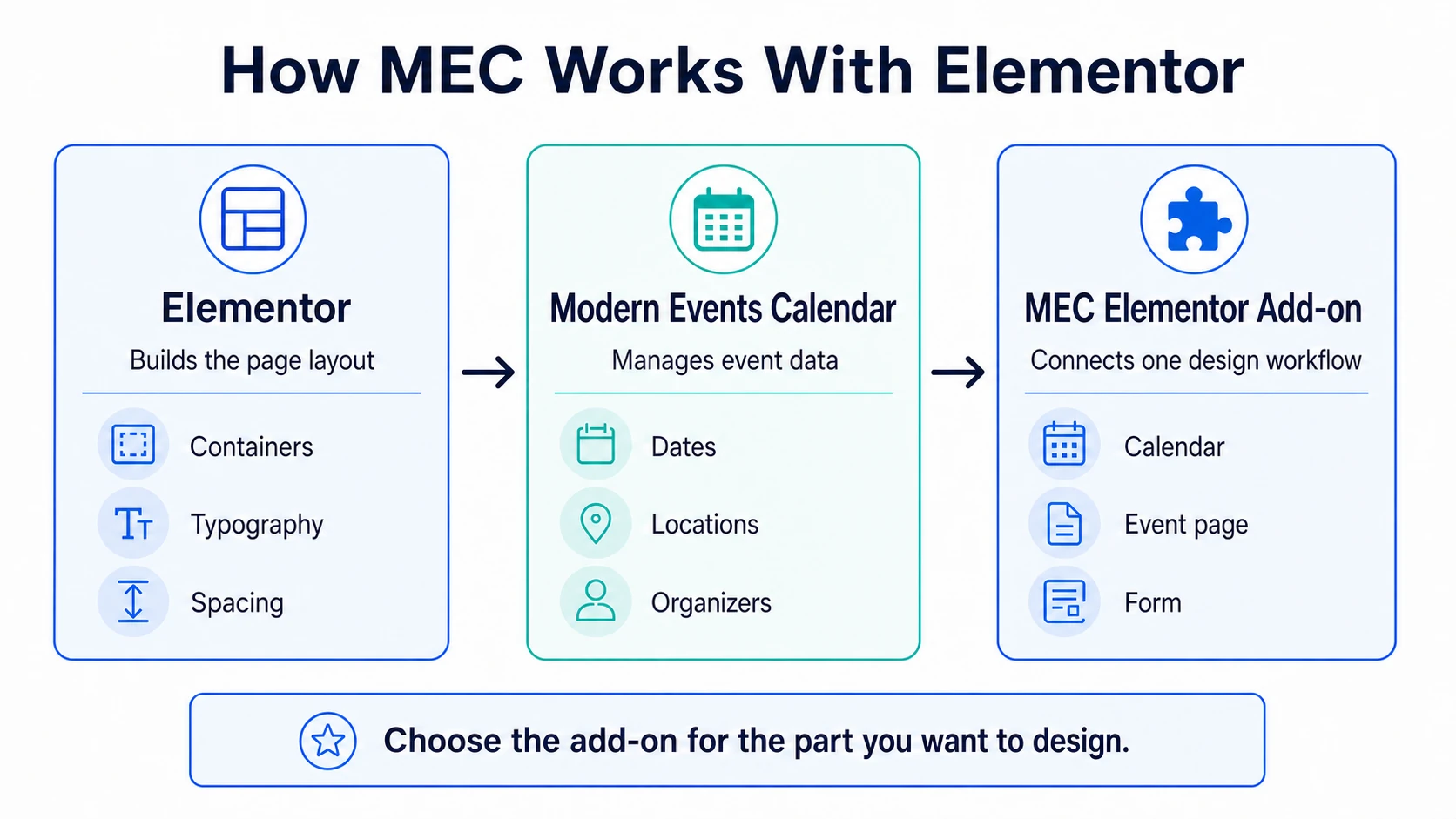
Those jobs require an event-management plugin. The plugin stores the event data and generates the views that visitors use. Elementor then helps control how selected views and pages appear.
This distinction matters when searching for an Elementor event calendar plugin. A calendar embed displays an outside calendar. An event plugin manages events inside WordPress.
If you need an event calendar in Elementor that uses WordPress event records, continue with the managed setup below.
Why use Modern Events Calendar on an Elementor website?
Modern Events Calendar gives WordPress the event layer that Elementor does not provide on its own. You create and manage events in MEC, then show that information as calendars, lists, grids, single-event pages, booking forms, or submission forms.
Using MEC with Elementor keeps event management and page design connected without turning every event into a manually maintained page. The result is an Elementor event calendar backed by reusable WordPress event records.
That division keeps the content structured. Change an event’s date or venue once in MEC and the connected view uses the updated data. You do not have to edit the same event details manually across several Elementor pages.
MEC also gives you two starting points:
- MEC Lite is suitable for users whose required event and display features are available in the free edition.
- MEC Pro adds paid features and is required for some workflows, including Elementor Form Builder for MEC booking forms.
Review the current MEC feature and edition details before choosing. The right edition depends on what visitors need to do, not simply on the fact that the site uses Elementor.
How does MEC integrate with Elementor?
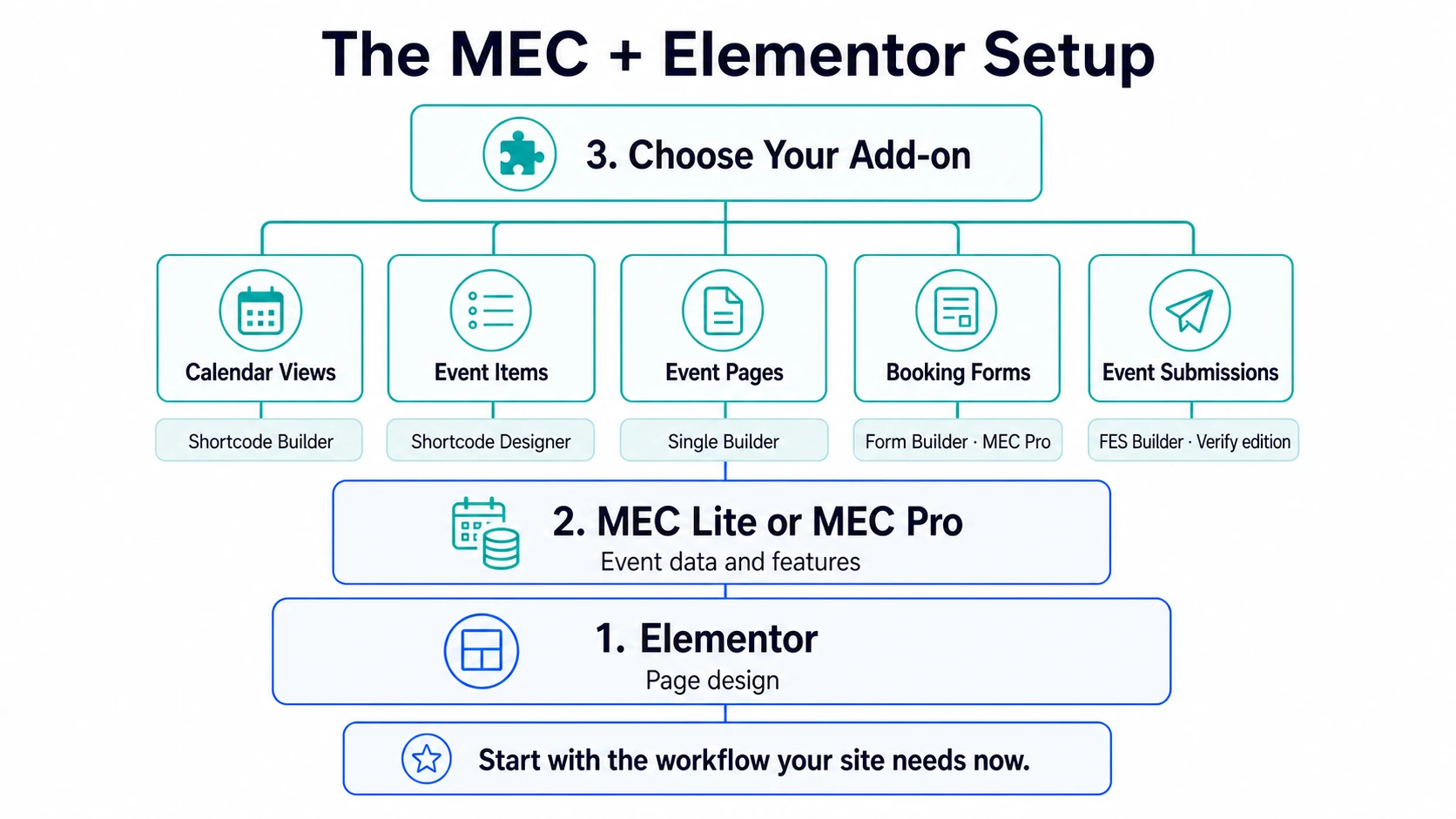
The MEC Elementor integration uses three parts. This is the basic architecture whenever you use MEC with Elementor:
- Elementor provides the visual editing environment and the surrounding page layout.
- MEC Lite or MEC Pro manages the event data and event features.
- A dedicated MEC Elementor add-on brings a specific calendar, template, or form workflow into Elementor.
The base MEC plugin does not include one complete set of Elementor widgets for every event workflow. The relevant MEC add-ons are installed separately. Your Elementor event calendar therefore combines the main event plugin with the builder for the selected task.
That is an important purchasing and maintenance detail. You may need to buy, install, update, and configure more than one product. In return, each add-on is focused on a defined job. A site that only needs a calendar view can start with Shortcode Builder. A site that also needs custom event pages can add Single Builder later.
The MEC Elementor integration can therefore begin with one add-on and grow only when another workflow becomes necessary.
Shortcode Designer takes the modular approach further. It exposes event-specific elements that can be arranged into custom event items, rather than limiting the design to one fixed calendar widget. The useful benefit here is workflow depth and choice. The result still depends on the add-on you select and the MEC features enabled on the site.
What do you need before you start?
For a basic event calendar for Elementor, prepare the following:
- A WordPress site with Elementor installed
- MEC Lite or MEC Pro, based on the event features you need
- Several complete test events with dates, locations, organizers, categories, and images
- Elementor Shortcode Builder for visual calendar and event-list placement
Follow the Modern Events Calendar installation guide if MEC is not active yet. When setting up MEC with Elementor, add realistic test events before designing the page. A populated calendar makes it much easier to judge spacing, filters, image sizes, and mobile behavior.
You do not generally need Elementor Pro for the documented MEC builders. Some MEC workflows do require MEC Pro. Elementor Form Builder is one confirmed example. However, the Elementor FES builder addon works with both Lite and Pro versions.
Learn how to customize an event registration form, for an improved user experience.
How to add an event calendar to Elementor with MEC
Elementor Shortcode Builder is the direct route for creating an event calendar in Elementor, including a calendar, grid, list, carousel, or other MEC view. Its name comes from MEC’s shortcode-based view system, but you configure the view inside Elementor rather than pasting a bare shortcode and accepting its defaults.
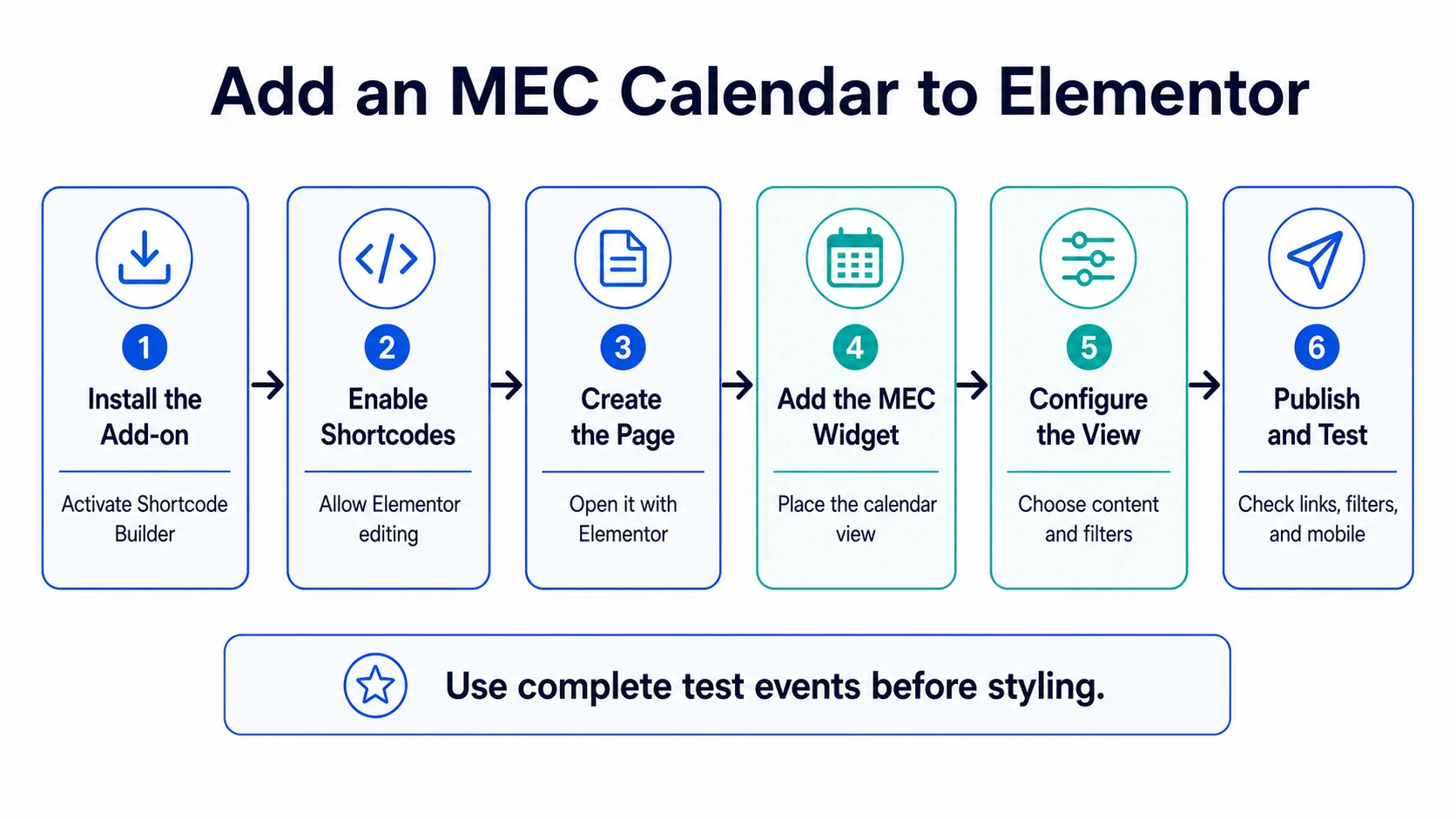
1. Install and activate Shortcode Builder
Install Elementor Shortcode Builder as a separate plugin. Confirm that Elementor and MEC are active first.
In Elementor’s settings, make sure the Shortcodes post type is enabled. This allows Elementor to edit the MEC view used on the page.
2. Create the page
Add a WordPress page for the calendar and open it with Elementor. Build the surrounding structure first: page heading, introductory copy, content width, and any navigation visitors need.
3. Add the MEC widget
Search the Elementor panel for the MEC Shortcode Builder widget and drag it into the page. Use the dedicated MEC widget when you want live access to its view and display controls. Elementor’s standard Shortcode widget can render an existing shortcode, but it does not expose the same MEC configuration workflow.
4. Choose the event view
Select a view that fits the visitor’s task. A monthly calendar supports date browsing. A list or grid works well when event titles, images, and summaries matter more than the month layout. Avoid choosing a view only because it looks attractive with two sample events. Test it with the amount of content the live site will carry.
5. Configure event content and discovery controls
Choose which event details appear and add the relevant search, category, date, or location controls. Keep the first version focused. Extra filters can add friction when the site has only a small event catalog.
6. Style, publish, and test
Use the available Elementor and MEC controls to align typography, colors, spacing, and container widths with the rest of the site. Publish the page and test it on the front end. Check event links, filters, recurring dates, empty states, and the mobile layout.
This gives you a working Elementor event calendar without rebuilding each event as an individual page. It is the shortest path for users who want an event calendar for Elementor and already have their event records in MEC.
Which MEC Elementor add-on should you choose?
Shortcode Builder solves the most common display task. An Elementor event calendar can then expand with another add-on when the site needs control over a different part of the event experience.
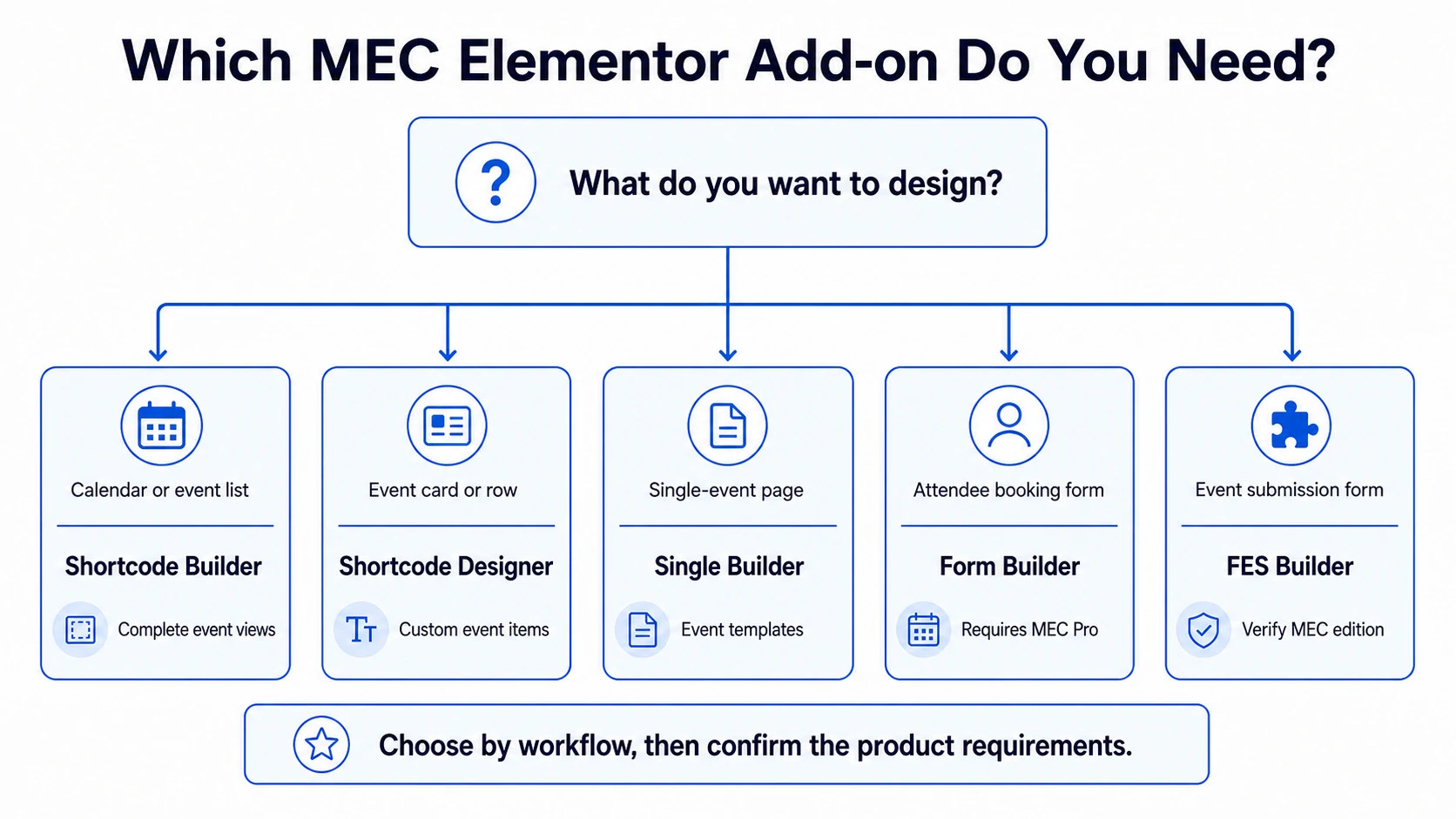
| What you want to customize | MEC add-on | What it controls | MEC requirement |
|---|---|---|---|
| Calendar, list, grid, carousel, or other event view | Elementor Shortcode Builder | MEC shortcode views placed and configured in Elementor | MEC Lite or Pro |
| Structure of a custom event item in a list or grid | Elementor Shortcode Designer | Event-specific elements and their arrangement | MEC Lite or Pro |
| The page for one event | Elementor Single Builder | Single-event templates and assignment rules | MEC Lite or Pro |
| The attendee booking form | Elementor Form Builder | Booking fields and form layout | MEC Pro |
| The front-end form used to submit an event | Elementor FES Builder | Event-submission fields and layout | [VERIFY: first-party pages conflict] |
The distinction between the two shortcode tools is easy to miss. Shortcode Builder configures a complete MEC view. Shortcode Designer creates the event-item design used within a supported view. Many sites need only the first one.
How far can you customize the event experience?
The modular integration lets you expand the site one workflow at a time. Once you use MEC with Elementor for the calendar view, the same event data can support the connected pages and forms below.
Calendar and event-list views
Use Shortcode Builder documentation to configure the main archive-style view in Elementor. This is the layer visitors use to browse or filter multiple events.
Custom event items
Use Shortcode Designer when the arrangement of individual event cards or rows needs deeper control. Its event-specific elements can be composed into a reusable design and assigned to a supported shortcode view.
Single-event pages
Use Single Builder to arrange event title, date, time, location, organizer, description, and other enabled modules on the page for one event. Templates can then be assigned according to the options provided by the add-on.
Booking forms
Use Form Builder when an MEC Pro booking form needs an Elementor-designed field layout. This form collects attendee information for a booking. It does not create a new event.
Front-end event submissions
Use FES Builder for a form that lets authorized users submit event information from the front end. This workflow collects event fields and needs a submit action. Confirm the current MEC edition requirement before buying the add-on.
What should you know before choosing this setup?
The main tradeoff in the MEC Elementor integration is the separate add-on model. The base plugin manages events, while Elementor editing is divided among tools for views, event items, event pages, booking forms, and submission forms. A project that needs several of those layers will have more licenses, plugins, settings, and updates to manage.
The model can also prevent unnecessary setup. You can install the tool for the immediate workflow and leave the others out. Each builder exposes controls related to its own event task, and Shortcode Designer supports granular event-item composition.
MEC’s main calendar displays are shortcode-based. Shortcode Builder makes those views easier to configure when you use MEC with Elementor, but the underlying approach differs from a plugin that places every function in one base Elementor widget set. Teams should include that architecture in their purchase decision.
Before committing, list the actual pages and forms the site needs. Price and verify that set of add-ons, check the MEC Lite or Pro requirement for each one, and test the workflow on a staging site.
Who is this setup best suited to?
An event calendar for Elementor built with MEC is a good fit when the website needs managed event records and control over one or more event-facing layouts. Common examples include recurring programs, venue calendars, classes, conferences, community listings, and sites with event submissions or bookings.
A simple public calendar embed may be enough when visitors only need to see dates maintained in Google Calendar and do not need WordPress event pages, event filters, structured organizer data, bookings, or submissions. That route has fewer moving parts.
Choose the Elementor event calendar setup according to the event workflow, not the number of design controls you can add. The smallest suitable stack is easier to operate, especially when you first connect MEC with Elementor.
Start with the event system, then add the design workflow
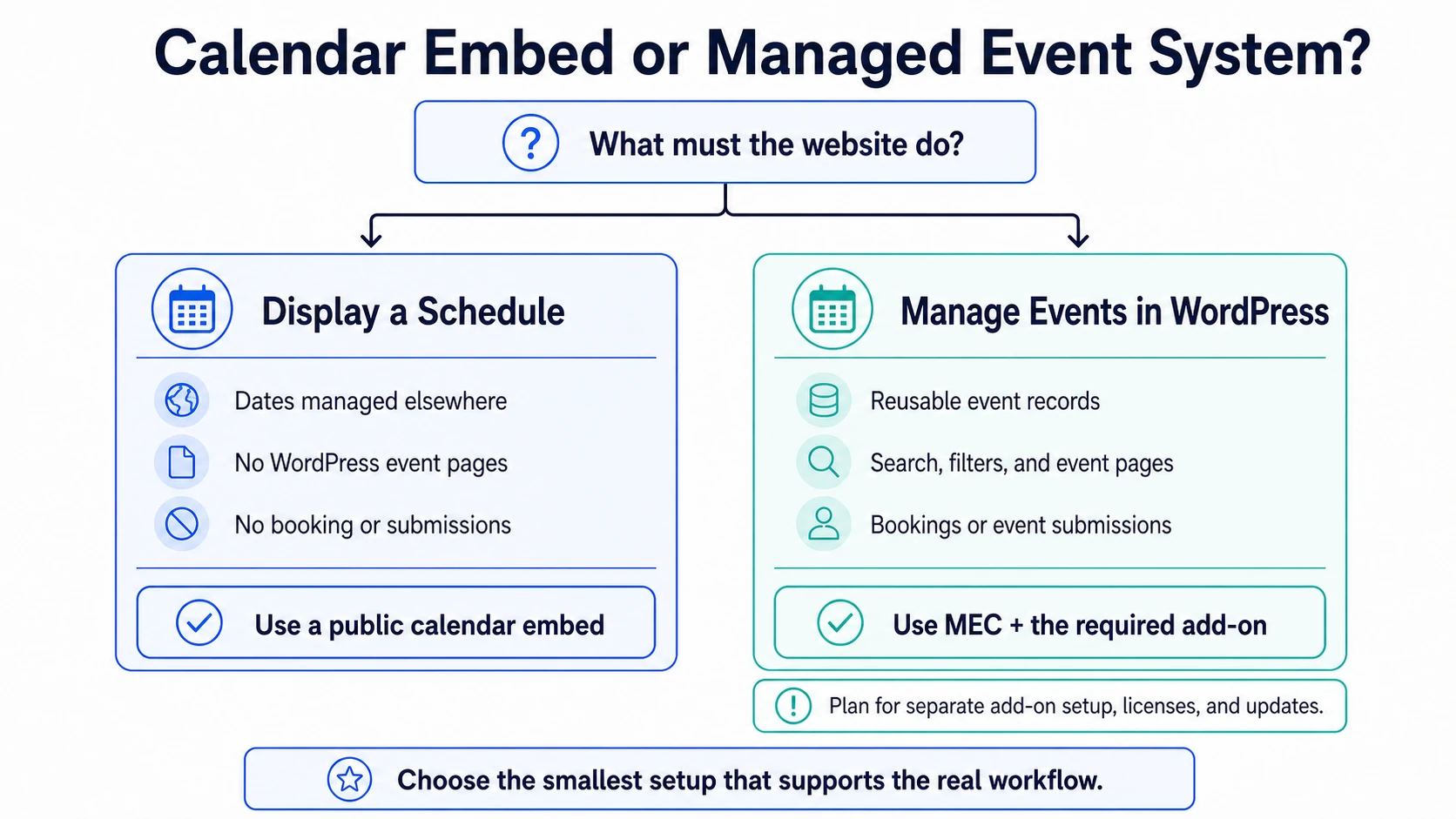
If your Elementor site needs searchable, reusable event data rather than a simple calendar embed, start by choosing MEC Lite or MEC Pro. Then add Shortcode Builder to create the first calendar or event-list page. This keeps the Elementor event calendar tied to one source of event data.
Expand the setup only when the project calls for another workflow. Shortcode Designer, Single Builder, Form Builder, and FES Builder each solve a different job. That approach keeps the Elementor event calendar focused on what visitors and site managers actually need.
If you are planning the entire site rather than only its Elementor layouts, follow the complete process to build an event website with WordPress and MEC.
Explore Modern Events Calendar and the current MEC Elementor add-ons before selecting the final stack.
Frequently asked questions
1. Can I use MEC with Elementor?
Yes. The MEC Elementor integration uses separate add-ons to bring specific calendar, template, and form workflows into the Elementor editor. Shortcode Builder is the usual starting point for an event calendar in Elementor.
2. Is MEC native to Elementor?
MEC is a WordPress event plugin that integrates with Elementor through dedicated add-ons. The base MEC installation does not provide one complete native Elementor widget set for all MEC workflows.
3. Do I need Elementor Pro?
The documented MEC Elementor builders do not generally list Elementor Pro as a requirement. Check the current product requirement before purchase because plugin requirements can change.
5. Which add-on adds a calendar to an Elementor page?
Elementor Shortcode Builder is the primary add-on for placing and configuring an MEC calendar, list, grid, carousel, or another shortcode view in Elementor. It is the usual first purchase for an event calendar for Elementor.
6. Can I customize event pages and forms too?
Yes. Single Builder controls single-event templates, Form Builder controls MEC Pro booking forms, and FES Builder controls front-end event-submission forms. Each is a separate add-on.